


CI/CD for AI Agents: Eval Gates, Canary Rollouts, and the AgenticOps Deployment Guide
A prompt tweak ships on Friday afternoon. By Monday morning, the customer-facing agent has hallucinated a refund policy that doesn’t exist, approved three transactions it should have escalated, and cost the team a weekend of manual cleanup. The post-mortem is familiar: “We tested it locally and it looked fine.”
- CI/CD for AI Agents: Eval Gates, Canary Rollouts, and the AgenticOps Deployment Guide
- Why Traditional CI/CD Breaks for AI Agents
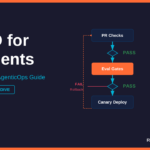
- The Four-Stage Agent CI/CD Pipeline
- Stage 1: PR-Time Checks (Under 90 Seconds)
- Stage 2: Merge-Time Integration Eval (5–15 Minutes)
- Stage 3: Pre-Deploy Simulation (10–60 Minutes)
- Stage 4: Canary Rollout and Automatic Rollback (1–24 Hours)
- The Eval Set: Your Most Important Git Artifact
- Tool Decision Matrix: Picking Your Eval Stack
- Risk-Tiered Validation: Not Everything Needs the Same Gate
- Production: Continuous Evaluation Never Stops
- Common Anti-Patterns to Avoid
- Putting It All Together: A Starter Checklist
- Frequently Asked Questions
- What’s the difference between CI/CD for AI agents and traditional CI/CD?
- How many test cases do I need in my evaluation dataset?
- Which eval tool should I use for AI agent CI/CD?
- How do I handle LLM-as-judge evaluation variance in CI/CD?
- How long does it take to set up a basic AI agent CI/CD pipeline?
- Key Takeaways
- References
This is the gap CI/CD for AI agents exists to close. Traditional CI/CD assumes deterministic builds — the same input produces the same output, and a passing test suite means the code works. AI agents break that assumption completely. Their outputs vary between runs, their quality degrades subtly rather than failing loudly, and a change to one component (a prompt, a model version, a retrieval index) can cascade through behaviors that no unit test anticipated.
The discipline emerging to handle this — sometimes called AgenticOps — treats agent deployments the way SRE treats service reliability: with layered gates, automated evaluation, canary traffic, and rollback triggers tied to quality metrics rather than error rates alone. This guide walks through the complete pipeline, from the first PR check to production canary, with the concrete patterns, tools, and decision frameworks practitioners are using in 2026.

Why Traditional CI/CD Breaks for AI Agents
Before diving into the pipeline, it’s worth being precise about what breaks. Three properties of AI agents make standard CI/CD insufficient.
Non-deterministic outputs. The same prompt to the same model can produce different responses across runs. Temperature, sampling, and model updates all introduce variance. An exact-match test that passed yesterday may fail today with an answer that’s equally correct. This means evaluation must be semantic — judging meaning, correctness, and safety rather than string equality.
Cascading component dependencies. An AI agent isn’t a single deployable unit. It’s a stack: system prompts, model versions, tool definitions, retrieval indices, guardrail policies, and orchestration logic. A prompt change may require a different RAG strategy. An embedding model update forces a full re-index. As the Harness.io engineering team notes, dependent layers should be tested and deployed in lockstep — not independently pushed and hoped to be compatible.
Silent quality degradation. A broken API throws a 500 error. A degraded agent returns a plausible but wrong answer with full confidence. Without continuous evaluation against quality baselines, teams discover regressions from user complaints, not monitoring dashboards. The AWS Well-Architected Agentic AI Lens identifies this as the most common anti-pattern: “quality measured once at release and never again.”
For teams coming from an RPA CI/CD background, the shift is significant. RPA bots produce deterministic outputs — a bot that extracts an invoice amount either gets the right number or throws an exception. AI agents operate in a fundamentally different quality space that demands purpose-built evaluation infrastructure.
More Read

The Four-Stage Agent CI/CD Pipeline
The pattern converging across the industry follows four stages, each trading speed for thoroughness. Think of it as a funnel: fast, cheap checks catch obvious problems early so expensive evaluations only run on code that’s already passed the basics.
Stage 1: PR-Time Checks (Under 90 Seconds)
The goal here is instant developer feedback. These checks run on every pull request and should complete before the developer context-switches away.
What runs at this stage:
- Prompt linting: Validate prompt templates for syntax, placeholder consistency, and structural rules (e.g., system prompts must include a safety preamble).
- Schema validation: Confirm tool definitions, function signatures, and output schemas are well-formed.
- Smoke suite: Run 15–20 curated test cases with deterministic scorers — exact match for structured outputs, Levenshtein distance for near-matches, regex patterns for format compliance.
The key constraint is speed. At this stage, you’re not running LLM-as-judge evaluations (too slow and expensive per PR). You’re catching the equivalent of lint errors and type mismatches — the problems that shouldn’t reach a reviewer’s eyes at all.
# .github/workflows/agent-pr-checks.yml
name: Agent PR Checks
on: [pull_request]
jobs:
  smoke-test:
    runs-on: ubuntu-latest
    steps:
      - uses: actions/checkout@v4
      - name: Validate prompt templates
        run: python scripts/lint_prompts.py --strict
      - name: Schema check tool definitions
        run: python scripts/validate_tools.py
      - name: Run smoke suite (20 cases)
        run: |
          python -m pytest tests/smoke/ \
            --timeout=60 \
            -x  # fail fast
Stage 2: Merge-Time Integration Eval (5–15 Minutes)
Once a PR passes smoke checks and human review, the merge trigger runs the full evaluation suite. This is where semantic evaluation enters the picture.
What runs at this stage:
- Golden-set evaluation: A versioned dataset of 100–500 test cases with expected behaviors (not exact answers), scored by LLM-as-judge evaluators across multiple dimensions — correctness, helpfulness, safety, coherence.
- Delta gating: The critical pattern here. Rather than requiring absolute scores, compare the PR’s evaluation results against the baseline (the current production version). Block the merge if any dimension regresses beyond a calibrated threshold.
- Per-rubric thresholds: Not every dimension deserves the same strictness. Safety evaluations should use a near-zero regression tolerance. Helpfulness scores can allow more variance.
The Braintrust eval-action GitHub Action (braintrustdata/eval-action@v2) implements this pattern well: it runs the evaluation suite, posts a PR comment showing per-metric deltas against baseline, and can block merges through a custom reporter that returns a failing status when thresholds breach. For teams building their own, the core logic is straightforward — the hard part is calibrating the thresholds so you catch real regressions without blocking on natural LLM variance.
The three-band decision framework that works in practice:
| Score Band | Action | Rationale |
|---|---|---|
| ≥ 0.9 (baseline) | Auto-merge | No meaningful regression |
| 0.7 – 0.9 | Human review required | Possible regression, needs judgment |
| < 0.7 | Auto-block | Clear regression, fix before merge |
For safety-critical dimensions, collapse the middle band: anything below 0.95 is an auto-block.
Handling flaky judges. LLM-as-judge evaluators are themselves non-deterministic. A single evaluation run can produce different scores for the same input. The fix: set trialCount (in Braintrust) or equivalent to run each test case 3–5 times, then gate on aggregate means rather than single samples. This smooths out judge variance while keeping genuine regressions visible. The cost multiplier (3–5× judge calls) is worth the reduction in false blocks.
For a deeper look at LLM-as-judge evaluation patterns, see our evaluation guide with LangSmith.
Stage 3: Pre-Deploy Simulation (10–60 Minutes)
After merge, before the new version touches production traffic, run the heavyweight evaluations that are too slow or expensive for the merge gate.
What runs at this stage:
- Multi-turn conversation replay: Feed recorded production conversations through the new agent version and compare trajectory and outcomes against the production version’s handling of the same conversations.
- End-to-end workflow testing: Execute full agent workflows including real tool calls against staging endpoints — not mocked services.
- Trajectory evaluation: Verify the agent calls the right tools in the right order, not just that it produces the right final answer. AWS Bedrock AgentCore offers three trajectory evaluators for this —
TrajectoryExactOrderMatchfor strict workflows,TrajectoryInOrderMatchfor flexible sequences, andTrajectoryAnyOrderMatchwhen order doesn’t matter. - Shadow testing: Run the new version alongside production using traffic mirroring, compare outputs without serving the new version’s responses to users. The AWS Well-Architected Agentic AI Lens recommends this as the final pre-production check, noting the cost of parallel inference infrastructure as a worthwhile trade for the safety it provides.
This stage is also where you run guardrail validation — confirming that prompt-injection defenses, PII scrubbing, and output schema enforcement all work correctly with the new agent version. As the Harness.io team emphasizes, treating guardrails as code and enforcing them through OPA policy gates means apps with missing or misconfigured input guardrails never reach production.
Stage 4: Canary Rollout and Automatic Rollback (1–24 Hours)
The final stage is a controlled production exposure. No amount of pre-production testing can perfectly replicate real user behavior, so the goal is to limit blast radius while gathering live quality signals.
The canary pattern for AI agents:
- Route 5–10% of traffic to the new agent version. The routing can be random, user-segment-based, or request-type-based depending on your architecture.
- Run online evaluation on the canary traffic — sample and score live responses using the same evaluator rubrics from Stage 2, but now against real-world inputs rather than curated test sets.
- Compare canary metrics against the stable version running the remaining 90–95% of traffic. Watch for: quality score degradation, safety metric violations, latency increases, token cost spikes, and tool-call failure rates.
- Auto-rollback on threshold violations. Define rollback triggers tied to your critical metrics. A single safety violation in the canary traffic should trigger immediate rollback. Quality degradation beyond your tolerance threshold (typically 5–10% drop from baseline) triggers rollback after a confirmation window.
- Gradually increase traffic if canary metrics hold — 5% → 25% → 50% → 100%, with evaluation at each step.
This maps directly to the observability infrastructure that an AgenticOps practice should already have in place. The canary stage doesn’t work without real-time quality dashboards to watch.
For cost-conscious teams, the FinOps angle matters here too: running two agent versions simultaneously during canary doubles your inference cost for that traffic segment, and running judge evaluators on live traffic adds per-request evaluation cost.
The Eval Set: Your Most Important Git Artifact
The evaluation dataset is the backbone of the entire pipeline. If the eval set is stale, unrepresentative, or too small, every gate built on top of it is unreliable.
Practical guidelines for eval set management:
Version alongside code. Store evaluation datasets in the same repository as the agent code, in a dedicated evals/ directory. When a prompt changes, the PR should include any new test cases the change requires. As the Braintrust documentation recommends, use a versioned dataset rather than inline data so PR and post-merge runs use the same cases.
Start with 20 high-signal cases for smoke, 200+ for the full suite. The smoke suite (Stage 1) needs to be small enough to run in seconds. The full eval suite (Stage 2) needs enough coverage to catch regressions across all agent capabilities. Build up from production failures — every incident should produce at least one new eval case.
Refresh from production regularly. The AWS Well-Architected guidance identifies stale test datasets as a critical anti-pattern. Set a cadence (weekly or biweekly) to review production traces, identify edge cases the eval set doesn’t cover, and add them. Braintrust’s pattern of turning production failures into regression test cases in the same PR as the fix is worth adopting regardless of which tool you use.
Score multi-dimensionally, gate on the worst. Don’t average your quality, safety, and efficiency scores into a single number — use min-aggregation. An agent that scores 0.95 on helpfulness and 0.3 on safety is dangerous, not “0.625 adequate.” Each dimension should have its own threshold, and the gate should fail if any dimension fails.
Tool Decision Matrix: Picking Your Eval Stack
The tooling landscape for agent evaluation CI/CD has matured considerably. Here’s a decision framework based on where you’re starting from.
| If you need… | Consider | Why |
|---|---|---|
| GitHub Actions-native eval with PR comments | Braintrust (eval-action@v2) | Posts score deltas on PRs, custom reporters for gating, TypeScript/Python/Go support |
| Cloud-provider-native agent eval | AWS Bedrock AgentCore Evaluations | 13 built-in evaluators, trajectory scoring, on-demand + online modes |
| Azure/Microsoft ecosystem integration | Azure AI Foundry (ai-agent-evals@v3-beta) | Confidence intervals, statistical significance testing, azd CLI gating |
| CLI-driven, provider-agnostic eval | Promptfoo | Config-driven, red teaming built in, works with any LLM provider |
| Open-source, self-hosted option | Arize Phoenix | ELv2 license, span/trace/trajectory eval, no vendor lock-in |
| LangChain/LangGraph ecosystem | LangSmith | Online evaluators with sampling, automation rules, annotation queues |
No single tool covers every stage of the pipeline perfectly. A common production pattern combines a lightweight CLI tool (Promptfoo or a custom script) for Stage 1 smoke tests, a platform-integrated evaluator (Braintrust, AgentCore, or Foundry) for Stage 2–3 semantic evaluation, and the platform’s online evaluation mode for Stage 4 canary monitoring.
Risk-Tiered Validation: Not Everything Needs the Same Gate
One of the sharper insights from the AWS Well-Architected Agentic AI Lens is that applying the same approval process to every change is itself an anti-pattern — either the process is too heavy for minor changes (so people bypass it) or too light for major ones (so risky changes slip through).
The three-tier model that works:
Tier 1 — Low risk (automated gates only): Minor prompt wording changes, logging configuration, non-functional updates. Run the full eval suite automatically; if it passes, deploy without human approval. This keeps velocity high for the changes that happen most often.
Tier 2 — Medium risk (automated gates + peer review): New tool integrations, prompt structure changes, model parameter adjustments. Run the eval suite, require a passing score, and require one human reviewer who understands the agent’s behavior to sign off. This is the category where most substantive agent improvements land.
Tier 3 — High risk (automated gates + multi-stakeholder approval): Autonomy level increases, new tool categories, model swaps, guardrail modifications. Run the full eval suite including shadow testing, require passing scores, require sign-off from a technical lead and a business owner. These changes alter the agent’s fundamental capabilities and deserve the highest scrutiny.
The automated evaluation always runs before any human reviewer sees the change. Failing automated checks never reach human reviewers — this protects reviewer attention for the changes that actually need judgment.
This tiered approach integrates with the control plane governance that enterprise teams need. The control plane enforces which tier a change falls into based on what files or configurations it touches.
Production: Continuous Evaluation Never Stops
Shipping through the four-stage pipeline doesn’t mean evaluation stops. Production quality degrades for reasons outside your deployment pipeline — model provider updates, data drift in your retrieval corpus, changing user behavior, upstream API changes.
Continuous online evaluation samples production traffic and scores it against the same rubrics used in pre-production evaluation. AWS Bedrock AgentCore Evaluations offers an “online mode” that does this automatically, sampling and scoring live traffic without manual triggers. For teams not on AWS, the pattern is straightforward to implement: sample N% of production requests, run them through your judge evaluators asynchronously, dashboard the scores over time, and alert when scores breach thresholds or show a persistent downward trend.
Tag every deployment. When quality shifts, the first question is “what changed?” Correlating quality metric movements with deployment timestamps, configuration updates, and model changes lets you attribute regressions to specific causes rather than hunting blind. This is a core observability practice that becomes essential at scale.
Test rollback quarterly. The AWS Well-Architected guidance recommends testing rollback procedures on a regular cadence and documenting the results. A rollback plan that’s never been executed is a rollback plan that won’t work when you need it at 3 AM.
Common Anti-Patterns to Avoid
Having worked through the full pipeline, here are the failure modes that trip teams up most often. For a broader catalogue, see our guide on why agentic automation fails.
Averaging across rubrics. A composite quality score hides dangerous regressions behind strong scores in other dimensions. Use per-rubric thresholds and min-aggregation. An agent that’s unsafe is unsafe regardless of how helpful it is.
Running eval only at release. Quality degrades between deployments due to model drift, data changes, and user behavior shifts. Continuous online evaluation catches these before users report them.
Exact-match testing on non-deterministic output. If your CI pipeline has assertEqual(agent.run(input), expected_output), you’ll either have a permanently-green test (the expected output is so generic it always matches) or a flaky test (it fails on valid but differently-worded responses). Use semantic evaluation.
Testing the agent without its tools. An agent that reasons correctly but calls tools incorrectly is a broken agent. Integration tests must include real tool calls against staging endpoints, and trajectory evaluators should verify tool-call sequences, not just final answers.
One approval process for all changes. Applying heavyweight review to prompt typo fixes teaches developers to route around the process. Applying lightweight review to model swaps lets dangerous changes through. Tier your gates to match the risk.
Putting It All Together: A Starter Checklist
For teams standing up an agent CI/CD pipeline from scratch, this is the minimum viable sequence:
- Version everything. Prompts, tool definitions, eval datasets, guardrail policies — all in git, all reviewed through PRs. See our version control and prompt management guide for the patterns.
- Build the eval set. Start with 20 smoke-test cases and 100 full-suite cases covering your agent’s core capabilities and known edge cases.
- Wire up Stage 1. PR-time linting and smoke tests. This can be done in an afternoon with standard GitHub Actions or any CI system.
- Add Stage 2. Integrate an LLM-as-judge evaluator (Braintrust, AgentCore, Promptfoo, or custom) for merge-time evaluation. Calibrate thresholds over 2–3 weeks of observing natural score variance.
- Implement Stage 4 before Stage 3. Canary rollouts with rollback triggers give you a production safety net while you build out the more complex pre-deploy simulation stage.
- Instrument continuous evaluation. Sample production traffic, score asynchronously, dashboard and alert.
- Iterate the eval set relentlessly. Every production incident becomes a test case. Every customer escalation gets analyzed for coverage gaps.
Frequently Asked Questions
What’s the difference between CI/CD for AI agents and traditional CI/CD?
Traditional CI/CD assumes deterministic outputs — the same code produces the same result every time. AI agent CI/CD must handle non-deterministic outputs using semantic evaluation (LLM-as-judge scoring, trajectory matching) rather than exact-match assertions. It also adds evaluation-specific stages like canary rollouts with quality-metric rollback triggers that don’t exist in standard CI/CD pipelines.
How many test cases do I need in my evaluation dataset?
Start with 15–20 cases for the smoke suite (Stage 1, must run in under 90 seconds) and 100–200 cases for the full evaluation suite (Stage 2). Scale to 500+ as your agent’s capabilities grow. Quality of cases matters more than quantity — each case should test a specific capability or edge case, and every production incident should generate at least one new test case.
Which eval tool should I use for AI agent CI/CD?
It depends on your stack. Braintrust offers the most turnkey GitHub Actions integration with PR comments and custom gating. AWS Bedrock AgentCore provides 13 built-in evaluators with trajectory scoring for AWS-native teams. Promptfoo is the best CLI-driven, provider-agnostic option. Arize Phoenix is the strongest open-source self-hosted choice. Most production setups combine two tools — a lightweight one for smoke tests and a platform evaluator for semantic scoring.
How do I handle LLM-as-judge evaluation variance in CI/CD?
Run each test case through the judge evaluator 3–5 times (using trialCount or equivalent) and gate on aggregate means rather than single samples. Set regression thresholds with margin — if natural variance across runs is ±3%, set your block threshold at 5–7% regression. For safety evaluations, use stricter single-case-level gating where any confirmed failure blocks the merge.
How long does it take to set up a basic AI agent CI/CD pipeline?
Stage 1 (PR-time smoke tests with prompt linting and schema validation) can be set up in a day. Stage 2 (merge-time eval with LLM-as-judge) takes 1–2 weeks including threshold calibration. Stage 4 (canary rollout) depends on your deployment infrastructure but typically takes 2–4 weeks. Stage 3 (pre-deploy simulation) is the most complex and can be built incrementally over 1–2 months. Start with Stages 1, 2, and 4 for the highest impact.
Key Takeaways
- Traditional CI/CD breaks for AI agents because outputs are non-deterministic, component dependencies cascade, and quality degrades silently rather than failing loudly.
- The four-stage pipeline (PR smoke checks → merge-time eval → pre-deploy simulation → canary rollout) provides layered quality gates that trade speed for thoroughness at each level.
- Delta gating — comparing PR scores against baseline rather than requiring absolute thresholds — is the key technique for handling natural LLM output variance while catching real regressions.
- Evaluation datasets are the most important artifact in the pipeline and should be versioned in git, refreshed from production failures, and scored across multiple dimensions using min-aggregation rather than averaging.
- Risk-tiered validation (auto-approve low-risk changes, require peer review for medium, multi-stakeholder for high) prevents both process fatigue and dangerous shortcuts.
- Continuous online evaluation after deployment catches quality degradation from model drift, data changes, and user behavior shifts that no pre-production test suite can anticipate.
References
- AWS Well-Architected Agentic AI Lens — AGENTOPS06: Testing, Evaluation, and Validation
- Harness.io — AI Deployment in Production: Orchestrate LLMs, RAG, Agents
- Microsoft Learn — Azure AI Foundry Evaluation GitHub Action
- Braintrust — LLM Eval Pipeline with GitHub Actions
- AWS Machine Learning Blog — Automated Agent Evaluation with Amazon Bedrock AgentCore and GitHub Actions
- Arize — LLM Evaluation Platforms: Top Frameworks


