


A procurement agent spins up at 2:14 AM to renegotiate a supplier contract. It authenticates to SAP Ariba with a service account, pulls pricing data from Snowflake using an API key, calls Claude via MCP to draft counter-terms, and routes the result to DocuSign for a human approver. By 2:17 AM it’s done — and nobody in security knows it happened.
- Why Agent Identity Is the Hardest Problem in Agentic AI
- What Workday Just Bought: C1.ai Under the Hood
- The Identity Graph
- MCP Gateway
- LLM Gateway
- Vault and Secrets Management
- Decoys: Honeypots for Agent Credential Misuse
- NHI Discovery
- Inline Authorization
- How C1.ai Fits Into Workday’s Agent System of Record
- The Competitive Landscape: Who Else Is Building Agent Identity
- What This Means for the EU AI Act and Regulatory Compliance
- Architectural Implications for Enterprise Agentic AI
- 1. Agent Identity Is Now a Platform Concern, Not an App Concern
- 2. MCP Governance Is Non-Negotiable
- 3. Plan for Agent Observability That Includes Identity
- What You Should Do Now: A Practitioner’s Checklist
- FAQs
- What is C1.ai and why did Workday acquire it?
- What is Workday’s Agent System of Record (ASOR)?
- How does C1.ai’s identity graph differ from traditional IAM?
- Does this acquisition affect enterprises not using Workday HCM?
- What is Agent Passport?
- Key Takeaways
That’s the identity crisis enterprises are waking up to. Not a hypothetical. Not a conference-keynote thought experiment. A real, operational gap that widens every time another team deploys another agent. And on November 23, 2026, Workday placed its bet on who closes it — completing the acquisition of C1.ai, an agentic identity platform that unifies human, non-human, and AI agent identities in a single graph (Workday Newsroom, Nov 2026).
This isn’t a talent acquisition dressed up as a product play. C1.ai ships a production identity infrastructure — MCP Gateway, LLM Gateway, vault, decoys, NHI discovery, inline authorization — that slots directly into Workday’s Agent System of Record. For enterprise architects building agentic automation at scale, this is the deal that reshapes how you think about agent identity, access, and trust.
Here’s what it means, what C1.ai actually does under the hood, and what you should be doing about it now.
Why Agent Identity Is the Hardest Problem in Agentic AI
Before we unpack the acquisition, it’s worth understanding why agent identity is fundamentally different from the identity problems enterprises have already solved.
Traditional identity management assumes three things: identities are created by humans, persist for months or years, and map 1:1 to a person or a known service. IAM systems — Okta, Entra ID, SailPoint — are built around this model. An employee joins, gets a directory entry, receives role-based access, and eventually offboards. The lifecycle is measured in quarters.
AI agents break all three assumptions. They are created programmatically, often at runtime. They persist for seconds to hours. And a single orchestration framework can spin up dozens of them in a single workflow, each with different tool access and data permissions. When Aneel Bhusri, Workday’s co-founder, told the audience at Workday Rising 2026 that enterprises will run “50 to 100 times more agents than human employees within three to five years,” he wasn’t projecting hype — he was describing the math that makes traditional IAM architecturally insufficient (Diginomica, Oct 2026).
The gap is specific and measurable. For every agent your team deploys, ask these five questions:
More Read

- Who created this agent? (Provenance)
- What credentials does it hold right now? (Inventory)
- What can it access, and for how long? (Scope)
- What did it actually do? (Audit)
- Is it still running, and should it be? (Lifecycle)
If you can’t answer all five in under two minutes, you have an agent identity gap. Most enterprises today can’t answer any of them. That’s what makes agent identity the hardest unsolved problem in agentic AI — not because it’s theoretically complex, but because the tooling didn’t exist. It was a recognized gap across the agent governance stack that vendors were racing to fill.
What Workday Just Bought: C1.ai Under the Hood
C1.ai isn’t a startup with a pitch deck and a beta. It’s a production identity platform, SOC 2 Type II certified, with 400+ connectors and a catalog of 3,000+ MCP servers. Founded to solve the specific problem of non-human identity (NHI) governance, it expanded into AI agent identity before most vendors acknowledged the category existed.
Here’s the architecture:
The Identity Graph
The core primitive is a unified identity graph that maps three identity classes — human users, non-human identities (service accounts, API keys, OAuth tokens, certificates), and AI agents — into a single, queryable data structure. This isn’t three separate directories stitched together by a sync engine. It’s one graph where the relationship between a human (the agent’s owner), an NHI (the credential the agent uses), and the agent itself (the runtime entity) is a first-class, traversable edge.
Why does this matter? Because when an AI agent authenticates to your ERP using a service account, the security question isn’t just “is this service account valid?” It’s “which agent is using this service account, who authorized it, what else has that agent accessed in this session, and does this action fall within its approved scope?” Answering that question requires the graph.
MCP Gateway
As agentic AI standardizes on the Model Context Protocol for tool access, the attack surface isn’t the LLM itself — it’s the MCP servers the LLM can reach. C1.ai’s MCP Gateway sits in front of every MCP server in the enterprise and provides three functions:
- Discovery: Automatic inventory of every MCP server, what tools it exposes, and which agents have connected to it
- Policy enforcement: Per-agent, per-tool authorization rules (Agent X can call the
read_databasetool but notwrite_database) - Audit trail: Every MCP tool call logged with agent identity, timestamp, parameters, and outcome
For architects who’ve been following the MCP protocol’s evolution toward stateless operation, the governance layer above the protocol is exactly what was missing. MCP defines how agents talk to tools. C1.ai’s gateway defines who’s allowed to talk, and remembers who did.
LLM Gateway
Separate from the MCP Gateway, the LLM Gateway is a policy enforcement layer between agents and foundation models. It governs:
- Which agents can call which models (your expense-report agent doesn’t need GPT-4 — it gets Haiku)
- Token budget enforcement per agent per session
- Content filtering and prompt injection detection at the gateway level
- Model routing based on agent trust level
This is the layer that prevents the classic “agent calls the most expensive model in an infinite loop” cost incident, and it enforces it at the identity layer rather than the application layer.
Vault and Secrets Management
C1.ai’s vault is built specifically for agentic workflows, which means it handles patterns that HashiCorp Vault and AWS Secrets Manager weren’t designed for:
- Ephemeral credentials: Agents get short-lived, scoped credentials that auto-expire when the task completes — no standing access
- Credential rotation: Agent credentials rotate automatically on a schedule or on anomaly detection
- Scope binding: A credential issued to Agent X for Task Y cannot be reused by Agent X for Task Z without re-authorization
The concept Workday Rising called “task-based identity” — where agents get scoped credentials for specific tasks rather than persistent role-based access — is implemented here. Bhusri described it as the agent equivalent of least-privilege, but dynamic: “The agent gets exactly what it needs for exactly as long as it needs it, and then it’s gone” (Diginomica, Oct 2026).
Decoys: Honeypots for Agent Credential Misuse
This is the feature that separates C1.ai from pure IAM vendors. Decoys are honeypot credentials — fake API keys, dummy service accounts, synthetic database connection strings — planted where a compromised or rogue agent might try to use them. If an agent touches a decoy credential, it triggers an immediate alert and quarantine.
The threat model is specific to agentic AI: prompt injection attacks that cause an agent to exfiltrate credentials, agents that exceed their authorized scope through emergent tool chaining, or insider threats where a developer intentionally programs an agent to access data it shouldn’t. Decoys catch all three patterns because they don’t rely on predicting the attack vector — they detect unauthorized credential use regardless of how it happened.
This aligns directly with the emerging practice of agent-specific security controls that treat agents as potentially adversarial principals, not trusted automation.
NHI Discovery
Before you can govern non-human identities, you need to find them all. C1.ai’s NHI Discovery engine scans across cloud providers, SaaS platforms, CI/CD pipelines, and internal systems to identify:
- Orphaned service accounts (the developer left; the service account didn’t)
- Over-privileged API keys (created with admin scope “just to test,” never scoped down)
- Dormant tokens (haven’t been used in 90 days but still have full access)
- Shadow agents (AI agents created outside the governed pipeline)
This is the same NHI security challenge that drove Palo Alto Networks to acquire Clutch Security for $500M — the recognition that non-human identities outnumber human identities by 10:1 or more in most enterprises, and most of them are ungoverned.
Inline Authorization
Rather than checking permissions at login time and trusting the session thereafter, C1.ai’s inline authorization evaluates every agent action against policy in real time. The agent calls a tool → inline authorization checks the agent’s identity, the tool being called, the parameters being passed, and the current policy → the call proceeds or is blocked, all in milliseconds.
This continuous authorization model is what makes the agent control plane concept practical at the identity layer. You’re not just controlling what agents can do at deploy time — you’re governing what they’re doing right now.
How C1.ai Fits Into Workday’s Agent System of Record
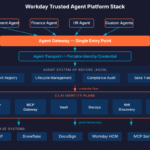
Workday didn’t buy C1.ai in isolation. It’s the third major piece — after the Sana acquisition ($1.1B for AI skills training) and the internally-built Agent System of Record (ASOR) — in what Workday is now calling the “Trusted Agent Platform.”
Here’s how the pieces compose:
Agent System of Record (ASOR) — Think of this as HR for AI agents. It’s the registry that knows every agent in the enterprise: who built it, what framework it runs on, what data it accesses, who owns it, and what its compliance status is. ASOR provides the lifecycle management layer: onboard → monitor → audit → retire. When Gerrit Kazmaier said C1.ai is “the final piece of our agentic strategy,” this is what he meant — ASOR had the registry and the lifecycle, but it was missing the identity and access layer (Workday Newsroom, Nov 2026).
C1.ai Identity Platform — Now provides the identity graph, credential management, and real-time authorization that ASOR needs to actually enforce its policies. ASOR says “this agent is authorized to process expense reports.” C1.ai issues the scoped credential, gates the MCP tool calls, and revokes access when the task completes.
Agent Passport (early access) — A portable identity credential that travels with an agent as it moves across systems. If your procurement agent needs to authenticate to SAP, then Snowflake, then DocuSign in a single workflow, the Agent Passport provides a consistent identity across all three — with an audit trail that follows the agent, not the individual system logs.
Agent Gateway — The single entry point for all agent traffic, sitting above the C1.ai identity layer. All agent requests route through the gateway, which enforces identity checks, rate limits, and policy before the agent touches any enterprise system.
Sana — The AI skills training platform adds what Workday calls “guardrails through learning” — the agent equivalent of compliance training. Rather than relying purely on runtime policy enforcement, Sana fine-tunes agent behavior during development based on enterprise-specific rules and norms.
For enterprise architects, the integration thesis is straightforward: Workday HCM already manages the lifecycle of every human in the enterprise. ASOR extends that lifecycle to AI agents. C1.ai provides the identity infrastructure that makes lifecycle management enforceable at the credential and access level. It’s the same pattern — HR knows people, HR now knows agents — just with a significantly harder technical problem underneath.
The Competitive Landscape: Who Else Is Building Agent Identity
Workday isn’t the only vendor who’s realized that agent identity is the linchpin of enterprise AI governance. Here’s how the market is shaping up:
Okta has been extending its workforce identity platform to cover non-human identities, with early-stage support for AI agent authentication. Their approach treats agents as a special class of NHI and leverages existing OIDC/OAuth flows. The strength is ecosystem — if you’re already an Okta shop, agent identity is an extension, not a rip-and-replace. The gap is the same gap that affects every traditional IAM vendor: agents don’t behave like the identities IAM was built for. They’re ephemeral, they chain tools dynamically, and they need runtime authorization, not session-based access.
SailPoint is approaching agent identity through the governance lens — their strength in identity governance and compliance extends naturally to governing who can create agents, what agents can access, and ensuring agent access is certified periodically. For regulated industries where compliance is the primary concern, SailPoint’s approach has merit.
Microsoft Entra ID has been adding agent identity features specifically for Copilot Studio agents. Their approach ties agent identity to the Microsoft identity graph, which works well in Microsoft-first environments but creates friction in multi-cloud, multi-vendor agent ecosystems. For teams building Copilot Studio agents with Entra ID integration, the Microsoft path is the path of least resistance — but it’s a walled-garden answer to what is fundamentally a cross-platform problem.
Palo Alto Networks (via Clutch Security) is approaching from the security side — their focus is on discovering and securing non-human identities as a security threat vector, not on governing agent lifecycle. It’s a complementary capability, not a competitive one.
HashiCorp provides the secrets management layer (Vault) that many agent frameworks already use, but doesn’t offer the identity graph or the agent-specific governance features that C1.ai provides above the credential layer.
What makes Workday’s position distinct is the HR thesis: they already own the system of record for human identity in the enterprise. If you buy the argument that agent lifecycle management looks like employee lifecycle management — onboard, train, monitor, review, offboard — then the company that manages the human lifecycle is the natural home for the agent lifecycle. It’s the same argument Bhusri made at Rising: “HR is the original identity system” (Diginomica, Oct 2026).
Whether that thesis holds depends on execution. The identity graph and MCP Gateway need to work at the latency and scale that agentic AI demands — agents making thousands of tool calls per minute across dozens of systems. That’s a different performance envelope than HR onboarding workflows, and it’s where C1.ai’s production-grade infrastructure needs to prove itself inside Workday’s platform.
What This Means for the EU AI Act and Regulatory Compliance
The timing of this acquisition isn’t accidental. The EU AI Act’s requirements for agent traceability and accountability are coming into force, and they demand exactly what a unified identity graph provides:
- Traceability: Every agent action traced to a responsible human (the identity graph’s owner edge)
- Accountability: Clear assignment of liability when an agent causes harm (the agent registry)
- Transparency: Documentation of what agents are deployed, what they can access, and what they’ve done (the audit trail)
- Human oversight: Demonstrable control mechanisms over agent behavior (inline authorization + kill switches)
Similarly, NIST’s emerging AI agent standards emphasize the need for agent identity, provenance tracking, and continuous monitoring — all core C1.ai capabilities.
For regulated enterprises — financial services, healthcare, government — the compliance argument alone may justify evaluating agent identity platforms now rather than waiting. The regulatory clock is ticking, and retrofitting identity governance onto an existing agent fleet is significantly harder than building it in from the start.
Architectural Implications for Enterprise Agentic AI
If you’re an enterprise architect building an agentic AI platform, the C1.ai acquisition changes three things about how you should think about your architecture:
1. Agent Identity Is Now a Platform Concern, Not an App Concern
Before this, most teams handled agent identity at the application layer — the agent framework itself managed credentials, the orchestration layer tracked permissions, and security was an afterthought. The emergence of dedicated agent identity platforms means identity should be extracted to the platform layer, the same way container orchestration extracted compute scheduling from the application layer.
Practically, this means your agent platform architecture should include an identity plane alongside your control plane and data plane:
- Control plane: Agent orchestration, workflow routing, human-in-the-loop (more on agent control planes)
- Identity plane: Agent identity, credential management, authorization, audit
- Data plane: Tool access, model access, data retrieval
2. MCP Governance Is Non-Negotiable
If your agents use MCP (and increasingly, they will), you need a governance layer above the protocol. An ungoverned MCP server is an open door — any agent that discovers it can call its tools. C1.ai’s MCP Gateway model — discover, inventory, authorize, audit — should be the minimum bar for any enterprise MCP deployment, regardless of whether you use C1.ai or build your own.
3. Plan for Agent Observability That Includes Identity
Agent observability without identity context is incomplete. Knowing that “an agent called the database 47 times in the last minute” is an alert. Knowing that “Agent X, owned by Team Y, using credential Z, called the database 47 times — and credential Z was scoped for read-only access to the HR schema, not the finance schema” is actionable intelligence. The identity graph is what turns observability data into governance insight.
What You Should Do Now: A Practitioner’s Checklist
The Workday/C1.ai deal signals that agent identity is moving from “emerging concern” to “platform feature” faster than most enterprises expected. Here’s what to do about it, in priority order:
This quarter:
- Inventory your agents. Build a registry of every AI agent in production — who built it, what credentials it uses, what systems it accesses, who owns it. If you can’t name every agent in your org, you can’t govern them.
- Inventory your NHIs. How many service accounts, API keys, and tokens exist in your environment? How many are orphaned, over-privileged, or dormant? This is your attack surface.
- Map agent-to-credential relationships. For every agent, document which credentials it uses and whether those credentials are shared, scoped, or over-privileged.
Next quarter:
- Evaluate agent identity platforms. C1.ai (via Workday), Okta, SailPoint, Entra ID, Clutch Security (via Palo Alto) — assess which fits your existing identity stack and your agent architecture.
- Implement MCP governance. If you’re deploying MCP servers, add an authorization layer. This can be as simple as an API gateway with agent-specific API keys, or as sophisticated as a dedicated MCP Gateway.
- Define agent lifecycle policies. Borrowing from HR: how are agents created (onboarded)? How are they monitored? How and when are they retired (offboarded)?
This year:
- Integrate agent identity into your compliance framework. EU AI Act, NIST, your industry-specific regulators — map agent identity controls to compliance requirements now, before the auditors ask.
- Build toward continuous authorization. Move from session-based access to per-action authorization for high-risk agent workflows. Start with agents that touch financial data, PII, or regulated systems.
FAQs
What is C1.ai and why did Workday acquire it?
C1.ai is an agentic identity platform that provides a unified identity graph for humans, non-human identities (service accounts, API keys), and AI agents. Workday acquired it to add identity and access governance to its Agent System of Record (ASOR), completing the trust infrastructure needed for enterprise-scale AI agent deployment. The acquisition closed on November 23, 2026.
What is Workday’s Agent System of Record (ASOR)?
The Agent System of Record is Workday’s platform for managing the full lifecycle of AI agents in the enterprise — registration, monitoring, compliance, and retirement. Think of it as “HR for AI agents.” With C1.ai integrated, ASOR now includes identity management, credential governance, and real-time authorization alongside its existing lifecycle management capabilities.
How does C1.ai’s identity graph differ from traditional IAM?
Traditional IAM systems (Okta, Entra ID, SailPoint) were designed for human identities that persist for months or years and authenticate through interactive flows. C1.ai’s identity graph handles AI agents that are ephemeral (lasting seconds to hours), authenticate programmatically, chain tools dynamically, and need per-action authorization rather than session-based access. It unifies all three identity types — human, NHI, and agent — in one queryable structure.
Does this acquisition affect enterprises not using Workday HCM?
Yes. The agent identity challenge exists regardless of your HR system. Even if you don’t adopt Workday’s ASOR, the C1.ai acquisition validates agent identity governance as a critical enterprise capability. The architectural patterns — unified identity graph, MCP governance, ephemeral credentials, continuous authorization — are vendor-agnostic concepts that every enterprise architect should evaluate.
What is Agent Passport?
Agent Passport is a Workday capability (currently in early access) that provides a portable identity credential for AI agents operating across multiple systems. Instead of an agent authenticating separately to each system it accesses, the Agent Passport provides a consistent, verifiable identity that follows the agent across its entire workflow — with a unified audit trail.
Key Takeaways
- Workday’s acquisition of C1.ai (closed Nov 23, 2026) creates the most comprehensive agent identity platform in the market, unifying human, NHI, and AI agent identities in a single graph integrated with Workday’s Agent System of Record.
- C1.ai’s core capabilities — MCP Gateway, LLM Gateway, vault, decoys, NHI discovery, and inline authorization — address the specific identity challenges that AI agents create and that traditional IAM systems weren’t designed to handle.
- The HR thesis — that the company managing human lifecycle is the natural home for agent lifecycle — is Workday’s strategic bet. Whether it holds depends on C1.ai’s ability to perform at agentic AI latency and scale requirements.
- Enterprise architects should treat agent identity as a platform concern (not an application concern) and begin inventorying agents, NHIs, and agent-to-credential mappings now.
- Regulatory pressure (EU AI Act, NIST AI agent standards) is accelerating the timeline — retrofitting agent identity governance is harder and riskier than building it in from the start.
- The competitive landscape includes Okta, SailPoint, Microsoft Entra ID, Palo Alto Networks (Clutch Security), and HashiCorp, each approaching agent identity from a different angle — no single vendor has the complete answer yet.

