

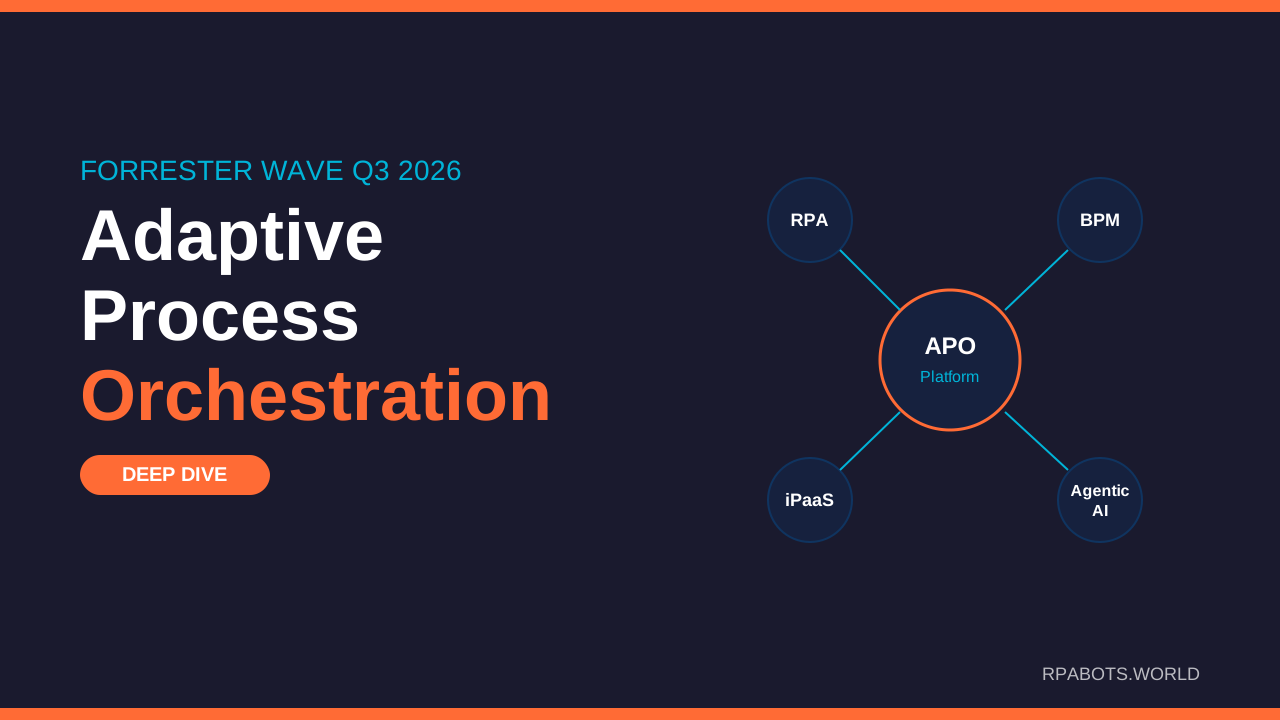

For two decades, enterprise automation meant choosing a lane: RPA for screen-level tasks, BPM for structured workflows, iPaaS for system integration. Forrester just declared that era over. The Forrester Wave™: Adaptive Process Orchestration Software, Q3 2026 — published in September 2026 and the analyst firm’s inaugural evaluation of this new category — assessed 13 vendors on their ability to blend deterministic workflow engines with AI agents that reason, adapt, and make autonomous decisions. Three confirmed Leaders emerged: UiPath, Camunda, and Boomi. A fourth Leader was named in the full report. For every RPA developer, solution architect, and automation leader reading this, the message is unmistakable: the platform that runs your bots today must also orchestrate your agents tomorrow — or it will be replaced by one that does.
- What Is Adaptive Process Orchestration — and Why Did Forrester Create a New Category?
- From 35 to 13: How the Vendor Field Was Narrowed
- The Leaders: UiPath, Camunda, Boomi — and One More
- UiPath — Superior Design Environment and Collaboration
- Camunda — Scalable, Reliable, Observable Process Orchestration
- Boomi — Vendor-Neutral Control Plane and Strategy Leader
- The Fourth Leader
- What the Evaluation Criteria Tell Us
- Why This Matters for RPA Teams Right Now
- 1. The Category Shift Is Official
- 2. Three Entry Points, One Destination
- 3. Governance Is Not Optional
- 4. LLM Flexibility Matters
- 5. Vendor-Neutral Integration Is a Differentiator
- How the APO Wave Relates to Other Analyst Evaluations
- The Broader APO Landscape: Who Else Is in the Mix?
- What to Do Next: A Practitioner’s Checklist
- Frequently Asked Questions
- What is the difference between RPA and Adaptive Process Orchestration?
- Does the Forrester Wave APO replace the Gartner Magic Quadrant for RPA?
- Who are the Leaders in the Forrester Wave APO Q3 2026?
- Should I switch platforms based on this Wave?
- What does “nondeterministic control flow” mean in practice?
- Key Takeaways
- External References
This guide unpacks exactly what Forrester’s new Adaptive Process Orchestration (APO) category means, why it matters to agentic AI architects, which vendors landed where, and what you should do about it right now.
What Is Adaptive Process Orchestration — and Why Did Forrester Create a New Category?
Forrester defines Adaptive Process Orchestration as “an automation platform that uses AI agents and nondeterministic control flows” alongside traditional deterministic control flows to meet business goals, perform complex tasks, and make autonomous decisions. The definition is deliberately broad because it captures a convergence that has been building for years but never had a single analyst label.
Before the APO category existed, enterprises evaluated automation vendors through separate lenses. Gartner’s Magic Quadrant for Robotic Process Automation (most recently published in 2025, naming both UiPath and Automation Anywhere as Leaders) covered bot-level task automation. Forrester’s own Digital Process Automation Wave covered structured workflow engines. iPaaS evaluations covered API-layer integration. None of these captured the reality that production automation in 2026 increasingly requires all three — plus AI agents — orchestrated under a single governance layer.
Analyst Bernhard Schaffrik, the report’s lead author, laid the groundwork in an April 2026 Forrester blog post announcing the evaluation. He argued that deterministic workflow engines, including RPA bots and digital process automation tools, lack the power needed for autonomous operations on their own. Reaching autonomous operations, he wrote, requires “combining automation technologies from different domains with a process mindset.” That combination is what Forrester now calls APO.
The Five Core APO Capabilities
The APO framework is organized around five capability areas that Forrester considers essential for agentic process management:
| Capability | What It Covers | Why It Matters for Agentic AI Architects |
|---|---|---|
| Option & Constraint Modeling | Defining decision boundaries, business rules, guardrails for agent behavior | Prevents agents from making decisions outside their approved scope |
| Content & Format Handling | Document processing, data extraction, format transformation across modalities | Agents need to consume and produce enterprise documents (invoices, contracts, emails) — not just API payloads |
| AI Agent Creation | Building, configuring, and deploying AI agents with reasoning capabilities | The platform must support agent development, not just bot recording |
| Agentic Orchestration & Governance | Coordinating multiple agents, managing handoffs, enforcing approval gates, audit trails | Multi-agent workflows without governance are a compliance risk — Forrester is signaling this is table stakes |
| Data & IP Protection | Access controls, data sovereignty, LLM data handling, IP safeguards | Enterprise AI agents touch sensitive data — the platform must protect it at the orchestration layer |
This five-pillar framework is significant because it tells vendors — and buyers — exactly where the bar is set. A platform that excels at bot recording but cannot create AI agents scores poorly. A platform with strong agent frameworks but no governance layer also falls short. The APO category forces a holistic evaluation.
From 35 to 13: How the Vendor Field Was Narrowed
The Wave was preceded by the Adaptive Process Orchestration Software Landscape, Q2 2026, a broader survey that mapped 35 vendors across the emerging APO market. That landscape report — also authored by Schaffrik — defined what separates genuine APO from rebranded automation, assessed which use cases to prioritize, and analyzed how vendors differ by industry, geography, and deployment model. Vendors recognized in the landscape included Newgen, Decisions, and Intrexx, alongside the larger players.

From that field of 35, Forrester selected the 13 vendors it considers “the providers that matter most” for the Wave evaluation. While the full list of 13 is available only in the paywalled report, the vendor announcements made public tell us the shape of the results.
The Leaders: UiPath, Camunda, Boomi — and One More
The Wave names four Leaders out of the 13 evaluated. Three have publicly confirmed their placement; the fourth has not made a public announcement as of this writing.
UiPath — Superior Design Environment and Collaboration
UiPath announced its Leader placement on October 7, 2026, via Business Wire. According to UiPath’s press release, the Forrester report states that “UiPath’s design environment provides superior collaboration and adaptivity.” Additional strengths cited include:
- An advanced context layer for maintaining process state across agent handoffs
- Orchestration testing capabilities
- Process observability and governance
- Autonomous design and an agent library with discovery features
- Strong handling of process complexity and volume
Customers praised UiPath’s “extensive, well-integrated functionality” and its out-of-the-box connectors to third-party systems. Arun Mehta, UiPath’s SVP of Product Management, framed the recognition as validation of UiPath’s strategy to bring “AI agents, robots, people, and systems together in a governed environment.”
For RPA teams already on UiPath, this placement confirms that UiPath’s investment in agentic capabilities like Autopilot is being recognized at the analyst level. The platform’s evolution from a screen-recording tool to a full process orchestration engine is now independently validated.
Camunda — Scalable, Reliable, Observable Process Orchestration
Camunda announced its Leader placement in a blog post and press release published in late September 2026. Forrester described Camunda as “best suited for large enterprises requiring scalable, reliable, and observable process orchestration.”
Camunda received the highest possible ratings on:
- Vision (highest possible rating)
- Adoption (5 out of 5)
- Reliability architecture
- Adaptivity architecture
- Process complexity and volume handling
- Operate and Optimize observability, control, and governance
Camunda’s placement is noteworthy because the company was historically positioned as a pure process orchestration engine — not an RPA vendor. Its inclusion as a Leader in the same Wave as UiPath illustrates Forrester’s thesis: APO is a convergence category where process orchestration vendors and RPA vendors now compete on the same playing field. For agentic AI architects evaluating orchestration options, Camunda represents the BPM-native approach to the same problem UiPath approaches from the RPA side.
Boomi — Vendor-Neutral Control Plane and Strategy Leader
Boomi announced its Leader placement on September 28, 2026, via Business Wire. It earned the highest score in the Strategy category — a distinction no other vendor has publicly claimed. Boomi received the highest possible scores on six criteria: design environment, adaptivity architecture, innovation, roadmap, adoption, and operational observability/control/governance.
Forrester highlighted several distinctive Boomi capabilities:
- A vendor-neutral control plane for agentic automation, enabling Boomi to function as a neutral orchestration layer across heterogeneous environments
- The Lunar.dev acquisition (an AI Gateway platform) that expanded Boomi’s ability to manage LLM routing and data handling
- LLM swapping capabilities, allowing enterprises to switch between language models without rewriting orchestrations
- Fine-grained data access controls and data sovereignty features — Forrester noted this matters especially for European enterprises
- A rich low-code development environment with DevOps integration, embedded context management, audit logging, and unified monitoring
Boomi’s strategy-first Leader placement is significant for integration-heavy enterprises. Where UiPath approaches APO from the RPA layer and Camunda from the process orchestration layer, Boomi enters from the iPaaS layer — and Forrester judged all three approaches worthy of Leader status. This three-path convergence is the core thesis of the APO category itself.
The Fourth Leader
The Forrester Wave names four Leaders in total. As of this writing, only UiPath, Camunda, and Boomi have made public announcements. The identity of the fourth Leader is available in the full report, which vendors including UiPath and Camunda offer as a complimentary download on their respective analyst-reports pages.
What the Evaluation Criteria Tell Us
While the full criteria set and weightings are available only in the report, the vendor announcements collectively reveal the dimensions Forrester used. These align with the five APO capabilities but are more granular:
| Evaluation Dimension | What Forrester Assessed | Which Leaders Scored Highest Here |
|---|---|---|
| Design Environment | How well the platform supports building and modifying orchestrations — collaboration, low-code/pro-code support, DevOps integration | UiPath (“superior collaboration and adaptivity”), Boomi (highest possible score) |
| Adaptivity Architecture | The platform’s ability to incorporate AI agents and nondeterministic flows alongside deterministic ones | Camunda, Boomi (both highest possible scores) |
| Reliability Architecture | Fault tolerance, error handling, recovery, uptime guarantees | Camunda (highest possible score) |
| Process Complexity Handling | Support for long-running, multi-step, conditional, and exception-heavy processes | Camunda, UiPath (both highlighted) |
| Process Volume Handling | Scalability under production workloads | Camunda, UiPath (both highlighted) |
| Operate: Observability, Control & Governance | Runtime monitoring, audit trails, approval gates, compliance controls | Camunda, Boomi (both highest possible scores) |
| Optimize: Observability, Control & Governance | Continuous improvement, process mining integration, performance optimization | Camunda (highest possible score) |
| Vision | Strategic direction and alignment with the APO category’s trajectory | Camunda (highest possible rating) |
| Roadmap | Planned capabilities and their credibility | Boomi (“above-par roadmap”) |
| Innovation | Novelty and impact of recent capabilities | Boomi (highest possible score) |
| Adoption | Market traction, customer base, growth | Camunda (5/5), Boomi (highest possible score) |
The criteria reveal Forrester’s priorities. Governance and observability appear twice — once for operations and once for optimization — underscoring that Forrester considers governance a first-class requirement, not an afterthought. This aligns with the broader agent governance trend across the industry.
Why This Matters for RPA Teams Right Now
If you are an RPA developer, solution architect, or automation CoE leader, this Wave has concrete implications for your platform strategy. Here is what changes:
1. The Category Shift Is Official
When Gartner renamed its RPA Magic Quadrant to include “agentic” in its review criteria (as evidenced by the 2026 Gartner Peer Insights for Agentic Process Automation Systems), it was a signal. When Forrester creates an entirely new category that absorbs RPA, BPM, and iPaaS into a single evaluation, it is a verdict. The question is no longer whether your RPA platform needs agentic capabilities — it is how well your platform scores when those capabilities are the primary evaluation criteria.
2. Three Entry Points, One Destination
The three confirmed Leaders represent three different starting points:
- UiPath: RPA-first, expanding into orchestration and agents
- Camunda: Process orchestration-first, expanding into agent-driven adaptivity
- Boomi: iPaaS-first, expanding into process automation and agentic control planes
Forrester judged all three paths as viable routes to Leadership. This tells architects that the “right” APO platform depends less on where the vendor started and more on how completely it covers the five APO capabilities — and how well it integrates with your existing stack.
3. Governance Is Not Optional
Every Leader scored highly on observability, control, and governance criteria. This aligns with what practitioners have been learning the hard way: deploying AI agents without governance creates compliance risk, unpredictable behavior, and audit failures. The APO category makes governance a scoring criterion, not a nice-to-have. If your current platform cannot show you what every agent is doing, why it made a decision, and who approved that decision, it will score poorly in any APO evaluation — whether internal or analyst-led.
4. LLM Flexibility Matters
Boomi’s recognition for LLM swapping capabilities and its Lunar.dev AI Gateway acquisition highlight an emerging requirement: enterprises need to switch between language models without rewriting their orchestrations. Today you might run on GPT-4o; tomorrow your compliance team might require an on-premises model for certain workflows. An APO platform that locks you into a single LLM provider creates a different kind of vendor lock-in — one that Forrester is now evaluating against.
5. Vendor-Neutral Integration Is a Differentiator
Boomi’s vendor-neutral control plane and UiPath’s praised third-party connectors both point to the same truth: in a multi-vendor enterprise, the orchestration layer cannot be a walled garden. Agents need to invoke tools across systems — calling an SAP function here, an Agentforce agent there, a legacy mainframe API elsewhere. The APO platform that connects the most systems wins the most complex use cases.
How the APO Wave Relates to Other Analyst Evaluations
The Forrester Wave APO does not replace existing analyst reports — it sits alongside them and adds a new dimension. Here is how to read them together:
| Analyst Report | Focus | Relationship to APO Wave |
|---|---|---|
| Gartner Magic Quadrant for RPA (2025) | Bot-level task automation, attended/unattended RPA | APO evaluates whether these bots can be orchestrated alongside AI agents under governance |
| Forrester Wave: Digital Process Automation (2025) | Structured workflow engines, case management | APO supersedes this by adding nondeterministic (agent-driven) control flows to the evaluation |
| Gartner Agentic Process Automation Peer Insights (2026) | User reviews of agentic automation platforms | Complementary — Gartner’s user-driven reviews plus Forrester’s analyst-driven evaluation |
| Forrester Wave: AI Platforms, Q3 2026 | General AI platform capabilities including governance and agent development | Overlapping but distinct — AI Platforms evaluates the AI engine; APO evaluates the orchestration layer |
For automation leaders building a business case, the APO Wave provides a new reference point. If your CEO asks, “Are we on the right platform?” you now have a Forrester evaluation that specifically measures the RPA-to-agentic transition — not just bot capabilities in isolation.
The Broader APO Landscape: Who Else Is in the Mix?
Beyond the 13 vendors in the Wave, the APO Landscape Q2 2026 mapped 35 vendors serving the broader market. While the full list is behind Forrester’s paywall, publicly confirmed participants include Newgen, Decisions, and Intrexx. The landscape covered how these vendors differ by industry focus, geographic strength, and deployment model — factors that matter for enterprises with specific regulatory or sovereignty requirements.
Several notable automation vendors have not publicly announced participation in the Wave itself. Automation Anywhere, Pegasystems, Appian, Microsoft (Power Automate), ServiceNow, and Salesforce all have orchestration capabilities that could qualify for APO evaluation, but without a public announcement, their inclusion or placement remains unconfirmed. The full report — available as a complimentary download from UiPath, Camunda, and Boomi — contains the complete vendor list and positioning.
What to Do Next: A Practitioner’s Checklist
Whether you are evaluating new platforms or assessing your current one against the APO criteria, here are concrete next steps:
If you are already on one of the Leaders (UiPath, Camunda, or Boomi):
- Download the complimentary Wave report from your vendor’s analyst-reports page to see exactly where your platform scored highest and where it has gaps
- Map your current automation portfolio against the five APO capability areas — you likely have strong coverage in two or three but gaps in others
- Prioritize agentic orchestration and governance capabilities in your next platform upgrade cycle
If you are on a platform not confirmed as a Leader:
- Download the report to see whether your vendor was evaluated and where it placed — Strong Performer is still a viable position for most enterprises
- Assess whether your vendor’s APO roadmap is credible — a Strong Performer with an aggressive roadmap may close the gap faster than a Leader with a plateauing investment
- Begin parallel evaluation of at least one Leader platform for your highest-value agentic use cases
If you are building a new automation practice from scratch:
- Use the APO Wave as your primary vendor shortlist — it evaluates exactly the capabilities you will need for the next three to five years
- Weight governance criteria heavily in your own evaluation — this is where enterprises fail fastest with agentic automation
- Consider whether your entry point is RPA (→ UiPath), process orchestration (→ Camunda), or integration (→ Boomi), and start with the Leader closest to your starting point
Frequently Asked Questions
What is the difference between RPA and Adaptive Process Orchestration?
RPA automates individual tasks by mimicking human actions on screens. Adaptive Process Orchestration goes further: it coordinates RPA bots, AI agents, API integrations, and human workers across end-to-end business processes — and it allows some of those steps to be nondeterministic, meaning an AI agent can reason about the best path rather than following a fixed script. APO platforms govern all of this under a single observability and compliance layer.
Does the Forrester Wave APO replace the Gartner Magic Quadrant for RPA?
No. The Gartner MQ for RPA evaluates bot-level automation capabilities. The Forrester Wave APO evaluates how well platforms orchestrate bots, agents, and integrations together. They measure different things and are most useful when read together — the MQ tells you how good the bots are; the APO Wave tells you how well those bots are governed and orchestrated alongside AI agents.
Who are the Leaders in the Forrester Wave APO Q3 2026?
Four vendors received Leader status. Three have publicly confirmed: UiPath, Camunda, and Boomi. The identity of the fourth Leader is available in the full report, which can be downloaded for free from the analyst-reports pages of UiPath, Camunda, or Boomi.
Should I switch platforms based on this Wave?
Not necessarily. The Wave is one input into a platform decision, not the only one. If your current vendor is a Strong Performer with a credible APO roadmap and your existing investment is significant, a platform switch may not be justified. However, if your vendor was not evaluated at all, or if it placed as a Contender with no visible investment in agentic capabilities, the APO Wave is a strong signal to begin evaluating alternatives.
What does “nondeterministic control flow” mean in practice?
In a deterministic workflow, every decision is pre-programmed: if condition A, do step B; if condition C, do step D. In a nondeterministic control flow, an AI agent evaluates the situation and chooses the best path based on reasoning — it might decide to escalate to a human, retry with different parameters, or take an entirely novel action within its approved scope. APO platforms support both types of control flow in the same orchestration.
Key Takeaways
- Forrester’s inaugural Adaptive Process Orchestration (APO) Wave, Q3 2026, creates a new analyst category that converges RPA, BPM, iPaaS, and agentic AI into a single evaluation framework.
- Three confirmed Leaders — UiPath, Camunda, and Boomi — represent three different entry points (RPA, process orchestration, and integration) into the same destination: governed, agent-ready process automation.
- APO is defined by five core capabilities: option and constraint modeling, content and format handling, AI agent creation, agentic orchestration and governance, and data and IP protection.
- Governance and observability are scored as first-class requirements, not optional features — enterprises without governance over their AI agents will fall behind.
- The APO Wave does not replace the Gartner RPA Magic Quadrant; they are complementary. Use both to evaluate platform readiness for the agentic era.
- The full report is available as a complimentary download from UiPath, Camunda, and Boomi — get it, read it, and use it to benchmark your own platform strategy.
External References
- UiPath, “UiPath Named a Leader in Adaptive Process Orchestration Software” (Press Release, October 7, 2026) — uipath.com
- Camunda, “Camunda Named a Leader in The Forrester Wave: Adaptive Process Orchestration Software, Q3 2026” (Blog, September 2026) — camunda.com
- Camunda, “Camunda Named a Leader in Adaptive Process Orchestration Software Evaluation, Q3 2026” (Press Release, September 2026) — camunda.com
- Boomi, “Boomi Named a Leader and Secures Highest Score in the Strategy Category” (Business Wire, September 28, 2026) — businesswire.com
- Boomi, “Boomi a Leader in The Forrester Wave™ Adaptive Process Orchestration Software, Q3 2026” (Blog, September 2026) — boomi.com
- iTWire, “Boomi recognised as a Leader in evaluation of agentic process orchestration software” (September 2026) — itwire.com
- Forrester, “Announcing The Evaluation Of The Adaptive Process Orchestration Market” (Blog, April 2026) — forrester.com
- Process Excellence Network, “Forrester identifies adaptive process orchestration as the future of enterprise automation” (2026) — processexcellencenetwork.com
- StockTitan / UiPath, “UiPath Recognized as a Leader in Analyst Evaluation for Adaptive Process Orchestration Software” (October 7, 2026) — stocktitan.net
- Newgen, “Newgen Recognized in Forrester’s The Adaptive Process Orchestration Software Landscape, Q2 2026” (2026) — newgensoft.com
- Decisions, “Decisions Named in Forrester’s Inaugural Adaptive Process Orchestration Landscape Report” (2026) — decisions.com


