


Gartner projects that more than 40 percent of agentic AI projects will be canceled by the end of 2027, citing escalating costs and inadequate controls as the primary culprits. Pegasystems looked at that forecast and bet the company’s next platform release on a single contrarian idea: don’t let agents improvise at runtime. The result is Pega Agentic Process Fabric — an orchestration layer that treats AI agents not as autonomous decision-makers but as participants in governed, auditable workflows. If your enterprise already runs mission-critical processes on Pega, or you are evaluating where agent orchestration fits inside a regulated stack, this guide breaks down the architecture, the pricing model, and the competitive tradeoffs you need to understand before your next planning cycle.
- What Is Pega Agentic Process Fabric?
- The Workflow-First Philosophy: Why Pega Rejects Prompt Engineering
- Architecture Deep Dive: The Three-Layer Stack
- Layer 1: Pega Blueprint — Design Agents
- Layer 2: Pega Predictable AI Agents — Workflow Execution
- Layer 3: Pega Agentic Process Fabric — Orchestration
- MCP and A2A Protocol Support: The Interoperability Play
- Pega Infinity 26: Flat-Fee AI Pricing Changes the Economics
- Enterprise Governance: The Compliance Architecture
- Legacy Modernization: Blueprint as a Migration Engine
- How Pega Compares: Enterprise Agent Platform Landscape
- Real-World Use Cases and Customer Signals
- What This Means for RPA Teams
- Getting Started
- Frequently Asked Questions
- What is Pega Agentic Process Fabric and how does it differ from regular RPA?
- Does Pega Agentic Process Fabric work with non-Pega AI agents?
- How does Pega’s flat-fee AI pricing work?
- Is Pega Agentic Process Fabric suitable for regulated industries?
- Can Pega Agentic Process Fabric help modernize legacy applications?
- Key Takeaways
- References
What Is Pega Agentic Process Fabric?
Pega Agentic Process Fabric is an extension of Pegasystems’ existing Process Fabric architecture, redesigned to orchestrate AI agents alongside traditional applications, systems, and data sources. Announced at PegaWorld in June 2025 and shipped as part of Pega Infinity 26 in July 2026, the fabric creates a unified registry where every discoverable agent, workflow, and data asset across the enterprise is cataloged and made available to an overarching orchestration agent.
In practical terms, the fabric does three things. First, it discovers and registers every Pega workflow, third-party AI agent, system integration, and data source connected to it. Second, it selects the optimal execution path — which might be a Pega workflow, an external agent, or a combination — for any given request. Third, it governs the entire interaction with step-by-step monitoring, audit trails, and compliance controls that satisfy regulated industries.
Pega CEO Alan Trefler framed the positioning bluntly: “Enterprises want the promise and power of automation that agents could offer, but we don’t think they want thousands of agents running unchecked, producing unreliable, undesirable results.” That philosophy shapes every design decision in the platform.
The Workflow-First Philosophy: Why Pega Rejects Prompt Engineering
Most enterprise agent platforms let AI models reason their way through tasks at runtime — the agent receives a goal, consults tools and data, and figures out the steps on the fly. Pega takes the opposite approach. AI reasoning happens at design time, when Blueprint AI agents help architects create and refine workflows. At runtime, those workflows execute through semantic AI — deterministic, auditable, and repeatable.
Trefler has been direct about why: “Anybody who’s asking people to write prompts where those prompts are going to run their business is setting themselves up for slews of challenges.” CTO Don Schuerman elaborated on the dual approach: “What we’ve taken is an approach that combines the power of agents to reason and think and act with the predictability that you get from workflows, from knowing that there are certain things you want to do in the business where you actually want to follow a predetermined path.”
This is not academic. In financial services, healthcare, and government — industries where Pega has deep installed bases — a single unpredictable agent action in a claims adjudication or loan underwriting workflow could trigger a compliance violation. The workflow-first model means that every agent action maps back to an approved process definition, and every deviation is flagged rather than silently executed.
What “Design-Time Reasoning, Runtime Execution” Actually Means
When a Pega customer needs a new business process, Blueprint AI agents analyze requirements, existing documentation, and best practices to propose a workflow. Architects review, modify, and approve it. Once approved, that workflow becomes immutable at runtime — the agent follows the steps, collects data, routes decisions, and escalates exceptions exactly as designed. The creative, potentially unpredictable AI reasoning is confined to the design phase, where human oversight is built into every approval gate.


This stands in contrast to platforms where agents re-reason each task execution. Pega’s bet is that enterprises will prefer predictable costs and auditable outcomes over the flexibility of unconstrained runtime reasoning — especially after the first wave of “agent sprawl” projects hits cost overruns and compliance issues.
Architecture Deep Dive: The Three-Layer Stack
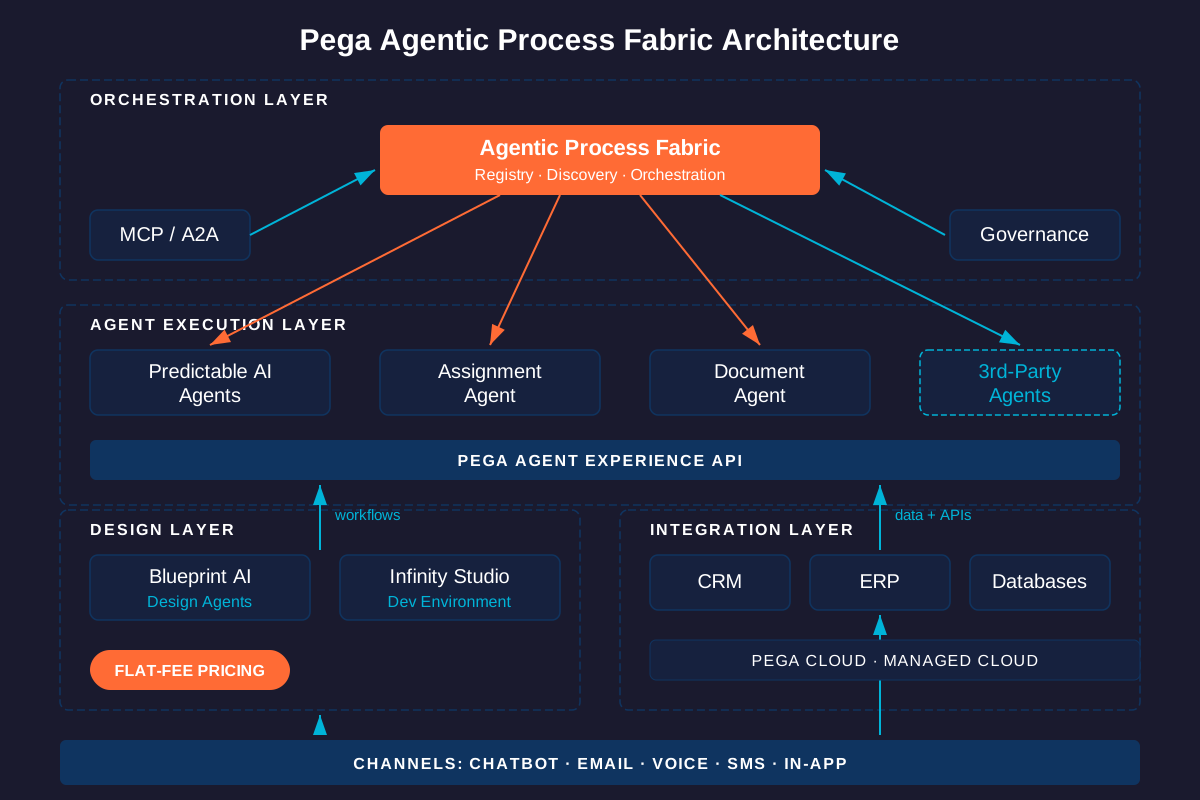
Pega Agentic Process Fabric is built on three integrated layers, each with a distinct role in the agent lifecycle.
Layer 1: Pega Blueprint — Design Agents
Blueprint is Pega’s AI-powered design environment. It functions as an agent itself — ingesting documentation, organizational best practices, customer data, and Pega’s own platform knowledge to generate optimized workflow definitions. Key capabilities include:
- Automated workflow generation from natural-language requirements
- Legacy system analysis — upload videos, screenshots, source code, or database schemas of existing applications, and Blueprint reverse-engineers modernized process definitions
- Industry template application — pre-loaded best practices for financial services, healthcare, insurance, and government workflows
- SI integration — system integrators like TCS and Credera can embed proprietary intellectual property into Blueprint’s knowledge base
Blueprint is currently available for free with a Pega user ID at pega.com/blueprint, a strategic move that puts AI-assisted design in the hands of prospects before they commit to the full platform.
Layer 2: Pega Predictable AI Agents — Workflow Execution
Once Blueprint produces an approved workflow, Pega Predictable AI technology converts it into a deployable agent via the Pega Agent Experience API. These agents combine workflow reliability with contextual AI reasoning — they follow the process definition step by step but use AI to handle natural-language interactions, document analysis, and decision support within the guardrails of the approved workflow.
Two pre-built agents ship with the platform:
| Agent | Function | Channels |
|---|---|---|
| Agentic Assignment Agent | Proactively contacts employees or customers when additional data or approvals are needed; routes work items to the right person based on context | Email, chat, telephony |
| Document Agent | Analyzes complex documents through splitting, categorization, boundary detection, confidence scoring, and triage; includes a conversational interface for PDF and image insights | In-app, API |
Organizations can build custom agents on top of this layer using Pega Infinity Studio, the AI-native development environment introduced in Infinity 26.
Layer 3: Pega Agentic Process Fabric — Orchestration
The fabric itself is the orchestration brain. It maintains the enterprise-wide registry of agents, workflows, data sources, and system integrations. When a request arrives — whether from a customer chatbot, an internal employee portal, or another agent — the fabric:
- Parses intent and determines what needs to happen
- Traverses the registry to find available agents and workflows that can fulfill the request
- Selects the optimal path — possibly combining a Pega workflow with a third-party agent (e.g., a Salesforce CRM lookup) in a single orchestrated flow
- Monitors execution step by step with full audit trails
- Escalates exceptions to human operators when confidence thresholds are not met
Multi-channel delivery is built in. Agents can engage users through chatbots, email, voice, SMS, and embedded in-app experiences without rebuilding the underlying workflow for each channel.
MCP and A2A Protocol Support: The Interoperability Play
Pega made a strategically significant move by supporting both the Model Context Protocol (MCP) and Agent-to-Agent (A2A) communication standards. With MCP support, every Pega application becomes an MCP server — meaning third-party agents from Anthropic Claude, Google Gemini, OpenAI, AWS AgentCore, and other MCP-compatible platforms can discover and invoke Pega workflows without custom integration code.
The A2A protocol enables direct agent-to-agent orchestration across platforms. In a practical scenario, a customer-facing Claude agent could discover a Pega claims-processing workflow via MCP, invoke it, and receive structured results — all governed by Pega’s compliance layer. For architects already building on the A2A and MCP standards that joined the Agentic AI Foundation, Pega’s adoption means one more enterprise-grade platform in the interoperable agent ecosystem.
The MCP integration extends to development tools as well. Pega Infinity 26 connects to Claude Code, GitHub Copilot, OpenAI Codex, Claude Cowork, ChatGPT, and Office 365 Copilot through MCP, allowing developers to build and modify Pega workflows using their preferred AI-assisted coding environments.
Pega Infinity 26: Flat-Fee AI Pricing Changes the Economics
Released on July 14, 2026, Pega Infinity 26 bundles Agentic Process Fabric with a pricing model that directly targets the biggest objection enterprises have to agentic AI: unpredictable token costs.
Instead of charging per token — where a complex agent interaction might consume thousands of tokens across multiple LLM calls, making cost forecasting nearly impossible — Pega charges a flat fee per resolved case. The company calls this “Pega Predictable AI” pricing, and it includes an AI Token Cost Calculator so prospects can compare their projected costs against token-based alternatives from competing platforms.
The economic argument is straightforward: if an agent resolves a customer service case, a claims triage, or a document classification task, the cost is the same regardless of how many LLM calls the workflow required internally. This eliminates the “AI token tax” that has caused some enterprises to throttle agent deployments after seeing their first production bills.
Key components of Infinity 26 beyond pricing:
- Pega Infinity Studio — AI-native development environment integrating coding agents with Blueprint best practices
- Pega Customer Engagement Studio — agent-powered workspace for marketers to create personalized 1:1 campaigns at scale
- Enhanced MCP integration — connects Blueprint, Studio, and the runtime platform to external AI coding tools
- Cloud deployment — available through Pega Cloud or managed cloud environments
Enterprise Governance: The Compliance Architecture
Governance is not a feature bolted onto the Agentic Process Fabric — it is the structural principle. Every agent interaction, whether initiated by a Pega agent or a connected third-party agent, passes through the same governance layer:
- Authentication and access control — agent access is restricted based on user identity, role, and the specific workflow being invoked
- Agent-to-agent interaction regulation — the fabric controls which agents can communicate with which other agents, preventing unauthorized lateral movement
- Step-by-step action monitoring — every action taken by every agent is logged with timestamps, inputs, outputs, and the workflow step that triggered it
- Compliance reporting — audit trails can be exported for regulatory review, with the ability to replay any agent interaction from start to finish
- Human-in-the-loop escalation — configurable confidence thresholds trigger automatic escalation to human operators for high-stakes decisions
CTO Don Schuerman has emphasized that this directly addresses the “black box problem” that plagues less governed agent platforms. In regulated industries — banking, insurance, healthcare, government — explaining why an agent made a specific decision is not optional. Because every Pega agent action traces back to an approved workflow step, the audit trail is inherently explainable.
For teams already evaluating agent governance frameworks, this is worth comparing against ServiceNow’s AI Control Tower approach and IBM watsonx Orchestrate’s control plane model — each takes a meaningfully different architectural approach to the same enterprise trust problem.
Legacy Modernization: Blueprint as a Migration Engine
One capability that differentiates Pega from pure-play agent platforms is Blueprint’s ability to serve as a legacy modernization engine. The workflow is practical: organizations record their legacy application interfaces, upload the recordings (videos, screenshots, source code, database schemas) to Blueprint, and the AI analyzes the functionality to produce modernized workflow definitions.
In a banking demo shown at PegaWorld, Blueprint analyzed a credit card management application and identified four distinct workflows to modernize: credit limit adjustments, account maintenance, transaction processing, and billing. Kerim Akgonul, Chief Product Officer, noted: “What Blueprint will do is go through and essentially what a human would do in months, it will just basically analyze all the content.”
This matters for the RPA community specifically. Many organizations that deployed RPA bots five to eight years ago to automate legacy system interactions now face a choice: maintain the bots as the legacy systems evolve, or modernize the underlying processes. Pega is positioning Blueprint as the path from “screen-scraping bots on a legacy app” to “governed agents on a modern workflow platform” — a migration pitch aimed squarely at enterprises sitting on aging RPA estates.
With 68 percent of IT decision makers reporting that legacy systems prevent modern technology adoption, the modernization play is arguably as strategically important as the agent orchestration capabilities.
How Pega Compares: Enterprise Agent Platform Landscape
The enterprise agent orchestration market is forming rapidly, with several major platforms competing for the same budget line item. Here is how Pega’s approach compares to the leading alternatives:
| Dimension | Pega Agentic Process Fabric | Salesforce Agentforce | ServiceNow AI Control Tower | IBM watsonx Orchestrate |
|---|---|---|---|---|
| Core philosophy | Workflow-first: AI reasons at design time, workflows execute at runtime | Agent-first: pre-built role-based agents with configurable guardrails | Governance-first: centralized control tower monitors autonomous agents | Skill-first: agents composed from reusable skill libraries |
| MCP support | Yes — every app becomes an MCP server | Yes — via Agentforce platform | Limited | Yes — via watsonx.ai integration |
| A2A protocol | Yes | Yes | Partial | Yes |
| Pricing model | Flat fee per resolved case | Per conversation / per agent | Subscription-based | Subscription + token consumption |
| Legacy modernization | Built-in via Blueprint AI | Limited | Limited | Via watsonx Code Assistant |
| Pre-built agents | Assignment Agent, Document Agent, Blueprint design agents | Sales, Service, Marketing, Commerce, and custom agents | IT, HR, Customer Service agents | HR, procurement, IT agents |
| Best fit | Regulated industries with existing Pega investments and complex workflow requirements | Salesforce-centric organizations wanting fast agent deployment | ITSM-heavy enterprises wanting centralized agent governance | Multi-cloud enterprises wanting vendor-neutral orchestration |
The philosophical difference is the key differentiator. Salesforce and ServiceNow let agents reason at runtime within guardrails. Pega confines all reasoning to the design phase. Neither approach is universally superior — the right choice depends on whether your processes are well-defined enough to model as workflows (Pega’s sweet spot) or require the flexibility of runtime reasoning (where Salesforce and ServiceNow have an edge).
For a deeper dive into how Salesforce Agentforce’s job-ready agents compare, or how Microsoft’s Agent Framework 1.0 fits into the picture, see our dedicated guides.
Real-World Use Cases and Customer Signals
While Pega has not published detailed case studies from Agentic Process Fabric deployments (the product only reached general availability in July 2026), several customer signals indicate where early traction is forming:
Financial Services
Erica van de Ven, Global Head of Financial Economic Crime Tech at Rabobank, stated: “We see incredible potential for deploying AI agents to improve efficiencies and deliver” better outcomes in financial crime detection. For banks, the governed workflow model aligns with anti-money laundering (AML) and know-your-customer (KYC) requirements where every decision must be documented and defensible.
Insurance Claims Processing
Claims adjudication is a classic Pega stronghold. With Agentic Process Fabric, a claims workflow can now incorporate a Document Agent to analyze submitted evidence, an Assignment Agent to route complex cases to specialist adjusters, and third-party agents (via MCP) to pull data from external systems — all within a single governed flow that satisfies state insurance regulatory requirements.
Customer Service Transformation
Pega Customer Engagement Studio, part of Infinity 26, enables contact centers to deploy agents that handle routine inquiries through workflow-governed conversations while escalating complex cases. The flat-fee pricing is particularly attractive here — high-volume customer service operations can budget agent costs per case rather than worrying about token consumption spikes during peak periods.
Legacy System Migration
Organizations using Blueprint to modernize legacy applications represent a less obvious but potentially high-value use case. Credera CEO Mahesh Agrawal highlighted the unified directory spanning both Pega and non-Pega systems, enabling “conversational agents to collaborate, trigger, and complete workflows seamlessly” — a capability that matters when the modernization target is not replacing the legacy system entirely but wrapping it in governed agent access.
What This Means for RPA Teams
If you are running an RPA center of excellence, Pega Agentic Process Fabric introduces a specific strategic question: where does workflow-governed agent orchestration fit alongside your existing bot estate?
The honest answer depends on your starting position. Teams already invested in Pega for case management, customer service, or decisioning have a natural upgrade path — the Agentic Process Fabric extends what they already run. Teams on UiPath, Automation Anywhere, or Power Automate are more likely to encounter Pega as a complementary orchestration layer than a bot replacement, especially if the organization already uses Pega for its core business processes.
The more important signal is the pricing model. Flat-fee-per-case pricing directly challenges the token-based economics that have made some enterprises hesitant to scale agentic deployments. If Pega’s model proves sustainable at scale, expect competitive pressure on other platforms to offer similar predictable-cost options — which would benefit the entire market. For a broader look at how Automation Anywhere and UiPath are approaching agentic process automation, see our procure-to-pay comparison.
Getting Started
For architects evaluating Pega Agentic Process Fabric, the on-ramp is straightforward:
- Try Blueprint for free — sign up at pega.com/blueprint to explore the AI-assisted workflow design experience
- Map your process inventory — identify which business processes are well-defined enough to model as workflows (Pega’s strength) versus those that require flexible runtime reasoning
- Evaluate MCP compatibility — if you are building agents on Claude, Gemini, or OpenAI, test interoperability through MCP connections to Pega workflows
- Run the AI Token Cost Calculator — compare Pega’s flat-fee model against your current or projected token costs on other platforms
- Engage an SI partner — Pega’s system integrator ecosystem (TCS, Credera, Cognizant, Accenture) can provide proof-of-concept support, especially for legacy modernization scenarios
Frequently Asked Questions
What is Pega Agentic Process Fabric and how does it differ from regular RPA?
Pega Agentic Process Fabric is an AI agent orchestration layer that coordinates agents, workflows, systems, and data across the enterprise. Unlike traditional RPA, which automates individual screen-level tasks through bots, Agentic Process Fabric orchestrates end-to-end business processes using AI agents governed by predefined workflows. The key difference is scope: RPA bots execute repetitive steps, while the fabric manages entire process outcomes across multiple agents and systems.
Does Pega Agentic Process Fabric work with non-Pega AI agents?
Yes. Through Model Context Protocol (MCP) and Agent-to-Agent (A2A) protocol support, the fabric can discover and orchestrate agents from Anthropic Claude, Google Gemini, OpenAI, AWS AgentCore, and other MCP-compatible platforms. Every Pega application becomes an MCP server, enabling third-party agents to invoke Pega workflows without custom integration.
How does Pega’s flat-fee AI pricing work?
Instead of charging per token consumed by LLM calls (which can vary unpredictably based on conversation complexity), Pega charges a flat fee per resolved case. This means the cost of processing a customer service inquiry, a claims adjudication, or a document classification is the same regardless of how many AI interactions the workflow required internally. Pega provides an AI Token Cost Calculator to compare this model against token-based pricing from other platforms.
Is Pega Agentic Process Fabric suitable for regulated industries?
It is specifically designed for them. The workflow-first architecture means every agent action maps back to an approved process definition with full audit trails, step-by-step monitoring, and compliance reporting. Agent access is controlled by authentication and role-based permissions, and agent-to-agent interactions are regulated to prevent unauthorized actions.
Can Pega Agentic Process Fabric help modernize legacy applications?
Yes, through Pega Blueprint. Organizations can upload legacy application assets — videos of user interactions, screenshots, source code, database schemas — and Blueprint AI will analyze them to produce modernized workflow definitions. This positions the platform as both an agent orchestration layer and a legacy modernization engine.
Key Takeaways
- Workflow-first, not prompt-first: Pega confines AI reasoning to design time and uses deterministic workflows at runtime — a fundamentally different architectural bet than most agent platforms.
- MCP and A2A native: every Pega application becomes an MCP server, making the platform interoperable with agents from Claude, Gemini, OpenAI, AWS AgentCore, and other MCP-compatible systems.
- Flat-fee pricing: Pega Infinity 26’s per-resolved-case pricing eliminates token-cost unpredictability — a direct response to the cost overruns that have stalled enterprise agent deployments.
- Governance by design: audit trails, access controls, agent-to-agent regulation, and human-in-the-loop escalation are structural, not optional add-ons.
- Legacy modernization built in: Blueprint AI can reverse-engineer legacy applications into governed agent workflows — a unique capability in the enterprise agent platform market.
- Best fit: regulated industries with complex, well-defined processes and existing Pega investments. Less suited to organizations that need maximum runtime agent flexibility for loosely defined tasks.
References
- Pega, “Pega Agentic Process Fabric Reliably Orchestrates End-to-End AI Automation,” Press Release, June 2, 2025.
- BusinessWire, “Pega Powers AI Agents to Reliably Drive Mission-Critical Work,” June 8, 2026.
- Constellation Research, “Pegasystems Launches Pega Agentic Process Fabric, Rides AI Momentum,” Liz Miller, 2026.
- Diginomica, “Pega’s Agentic Approach Puts Workflows First, Prompts Second — Here’s Why That Matters,” 2026.
- SiliconANGLE, “Pegasystems Expands Features to Build and Manage AI Agents,” June 2, 2025.
- DevOps Digest, “Pega Infinity 26 Released,” July 2026.
- BriefGlance, “Pegasystems Launches Pega Infinity 26 with Flat-Fee AI Pricing Model,” 2026.
- Pega, “Pega Infinity 26 Now Available to Deliver Predictable Outcomes with Predictable AI Costs,” BusinessWire, July 14, 2026.
- CX Today, “Pegasystems Has Put a Price on Agentic Customer Service. Buyers Need the Fine Print,” 2026.


