


The average Fortune 500 company will operate more than 150,000 AI agents by 2028 — up from fewer than 15 in 2025. That is a ten-thousand-fold increase in autonomous software entities making decisions, calling APIs, and spending tokens on your dime. And according to Gartner, only 13% of enterprises consider their agent governance “sufficiently mature” to handle even their current fleet.
- What Is an AI Agent Management Platform? Gartner’s Definition
- Why This Report Matters Now
- The Complete Quadrant: All 13 Vendors Mapped
- Five Patterns Every Architect Should Take Away
- 1. The Identity Layer Is the Real Battleground
- 2. The iPaaS and API Gateway Vendors Are Serious Contenders
- 3. RPA Vendors Are Pivoting, but the Fit Is Not Automatic
- 4. Open Source Has a Seat at the Table
- 5. Tokenomics Is the New FinOps
- How to Evaluate an AMP: The Practitioner’s Checklist
- The Market Landscape: Where Things Stand and Where They Are Heading
- What This Means for RPA Teams Specifically
- FAQs
- What is an AI Agent Management Platform (AMP)?
- How is an AMP different from an AI agent builder?
- Is Gartner’s MQ the only analyst report on agent management platforms?
- Should I choose a Leader vendor by default?
- When will the next edition of this MQ be published?
- Key Takeaways
- References
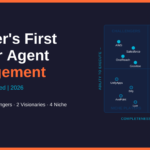
On October 27, 2026, Gartner published its first-ever Magic Quadrant for AI Agent Management Platforms (AMPs) — a landmark recognition that managing AI agents has become a market category in its own right, not merely a feature bolted onto existing infrastructure. The report evaluated 13 vendors across two axes — Completeness of Vision and Ability to Execute — and the results reveal a market that is forming fast, fragmenting along predictable fault lines, and far from settled.
This guide breaks down every quadrant position, explains what Gartner is actually measuring, and — most importantly — tells you what this report means for the architects, developers, and automation leaders who have to choose a platform before the market consolidates.
What Is an AI Agent Management Platform? Gartner’s Definition
Gartner defines AI Agent Management Platforms as “centralized software platforms that manage AI agents independent of where they are deployed.” In practice, an AMP is the control plane for your enterprise’s agentic AI estate. It sits above individual agent frameworks (LangGraph, CrewAI, Copilot Studio, Agentforce) and provides a unified layer for:
- Agent discovery and registration — knowing which agents exist, where they run, and what they do
- Lifecycle management — deploying, versioning, retiring, and rolling back agents
- Guardrail enforcement — applying content, safety, and grounding policies consistently across all agents
- Agent evaluation — benchmarking quality, accuracy, and reliability in production
- Identity and access management — assigning nonhuman identities, enforcing least-privilege, and auditing who (or what) did what
- Integration controls — managing MCP servers, A2A connections, API calls, and data access
- Cost tracking and tokenomics — tying token spend to business outcomes, not just usage meters
The key insight in Gartner’s framing is that AMPs are vendor-neutral by design. They must manage agents built on different frameworks, running on different clouds, and calling different models. If a platform only manages its own agents, it is an agent builder, not an agent management platform.
Why This Report Matters Now
Three forces converged to make this MQ inevitable:
1. Agent sprawl is real and accelerating. Gartner projects that by 2029, 60% of enterprise AI agents will be managed through a dedicated AMP. The alternative — managing agents through spreadsheets, ad-hoc scripts, and hope — does not scale past a few dozen agents, and most large enterprises are already past that threshold.
2. Governance is the bottleneck, not capability. Building an AI agent takes days. Governing it in production — identity, audit trails, cost controls, compliance with the EU AI Act and emerging NIST standards — takes months. The enterprises that solve governance first will deploy faster, not slower. As Gartner notes, over 35% of enterprise AI run budgets will ultimately be allocated based on verified business outcomes rather than raw token consumption.


3. The control-plane market is forming before anyone expected. Six months ago, “agent management” was a feature in a vendor’s slide deck. Today it is a Gartner Magic Quadrant with 13 evaluated vendors, a companion Critical Capabilities report, and a clear signal that this is where enterprise buying decisions will concentrate in 2027 and beyond. This follows Gartner’s broader validation of the agentic AI space through its Hype Cycle for Agentic AI, which positioned agent management platforms as approaching the Peak of Inflated Expectations.
The Complete Quadrant: All 13 Vendors Mapped
Below is every vendor evaluated in Gartner’s inaugural MQ, organized by quadrant position. For each, we cover what they bring, where they excel, and where the gaps are.
Leaders
Leaders demonstrate both a comprehensive vision for where agent management is heading and a proven ability to execute on that vision today. Three vendors earned this designation.
Microsoft
Microsoft’s AMP story is built on Agent 365 and the broader Microsoft Agent Framework ecosystem. The core differentiator is an identity-first approach: AI agents receive nonhuman identities through Microsoft Entra, giving them the same identity governance primitives (least-privilege, conditional access, audit logging) that human users receive. Defender provides runtime security monitoring, Purview handles data governance and compliance labeling, and Intune extends device-level management to agent endpoints.
Microsoft’s strength is depth of integration: if your enterprise is already on Microsoft 365, Azure, and Entra, the AMP layer slots in with minimal friction. The challenge is lock-in — organizations running agents on AWS Bedrock or Google Vertex alongside Azure may find cross-cloud management thinner than the Azure-native experience.
IBM
IBM watsonx Orchestrate combined with watsonx.governance forms IBM’s AMP stack. The standout capability is tying agent performance to business outcomes — not just “did the agent complete the task?” but “did the task move the KPI the business actually cares about?” IBM’s governance layer tracks model drift, compliance adherence, and explainability in a single pane.
IBM also leads on sovereign and air-gapped deployments. For regulated industries (banking, defense, healthcare) that cannot send agent traffic through public clouds, IBM offers fully on-premises agent management — a capability most competitors cannot match. The tradeoff is complexity: IBM’s stack has a steeper learning curve and longer deployment timeline than cloud-native alternatives.
ServiceNow
ServiceNow’s approach treats AI agents as configuration items (CIs) in its Configuration Management Database (CMDB) — the same system that tracks servers, applications, and network devices. This means agents get automatic discovery (ServiceNow finds agents you did not know existed), dependency mapping (which agents depend on which APIs, data sources, and models), and change management (agent updates go through the same approval workflows as infrastructure changes).
The platform layers on risk, compliance, cost, and value analytics specifically designed for agentic workloads. If your enterprise already runs on ServiceNow for ITSM, the agent management layer inherits your existing approval workflows, SLA definitions, and incident response playbooks. The limitation is that ServiceNow’s AMP capabilities are strongest within its own ecosystem — managing agents deployed on third-party platforms requires additional integration work.
Challengers
Challengers demonstrate strong execution capability but may have a narrower vision or less comprehensive roadmap than Leaders. Four vendors sit here.
Amazon Web Services (AWS)
Bedrock AgentCore is AWS’s agent management offering. Its strongest capability is Cedar authorization policies — a declarative, fine-grained access control language that lets architects define exactly what each agent can access, down to the API call and data field level. Runtime guardrails enforce content safety, grounding, and cost limits in the agent execution path rather than as an afterthought.
AWS also offers GovCloud and sovereign cloud deployments for regulated workloads. The Challenger (not Leader) placement likely reflects Gartner’s assessment that AgentCore is developer-centric — powerful for teams with deep AWS expertise but lacking the pre-built vertical workflows and business-outcome dashboards that Leaders provide out of the box.
Salesforce
Salesforce brings Agent Fabric and Agentforce to the AMP conversation, with a distinctive angle: cross-platform agent discovery and governance. Agent Fabric can discover and manage agents deployed across AWS, Microsoft, Google, ServiceNow, SAP, and Snowflake — not just Salesforce’s own platform. This multi-vendor visibility is rare and addresses a real pain point for enterprises running heterogeneous agent estates.
Gartner’s concern centers on cost predictability. Salesforce’s pricing model mixes subscription licenses, credits, and usage-based metering in ways that can make total cost of ownership difficult to forecast — a significant issue for the FinOps dimension that AMPs are supposed to solve.
OneReach.ai
OneReach.ai GSX is the platform that most enterprises have not heard of — and it landed as a Challenger anyway. GSX offers multi-agent orchestration with shared memory, human-in-the-loop oversight, and a Communication Fabric that provides session management and full audit logging across all connected agents.
OneReach’s differentiator is protocol-native integration: agents from Salesforce, ServiceNow, Microsoft, LangChain, and custom builds register into GSX via MCP and A2A protocols, and a single guardrail policy (content safety, sensitive data handling, grounding verification) applies to all of them. The platform uses fixed-capacity pricing rather than per-token or per-agent metering — a model that simplifies FinOps but may limit flexibility for burst workloads. OneReach provides 24/7 support, a rarity among AMP vendors.
Gravitee
Gravitee enters the MQ from the API management side. Its thesis: AI agents are, at their core, API consumers and producers, so the control plane for agents should be an evolution of the API gateway, not a separate system. Gravitee’s AI Agent Gateway extends traditional API management (rate limiting, authentication, transformation) with agent-specific capabilities: agent discovery, policy enforcement, and traffic analytics tuned for agentic workloads.
Gravitee claims that 80% of organizations ship AI agents without adequate security, and positions its gateway as the missing infrastructure layer. The API-native approach resonates with platform engineering teams who already manage API gateways and want to extend that investment rather than deploy a wholly new platform.
Visionaries
Visionaries have a strong, forward-looking vision for the market but may still be building the execution muscle to match. Two vendors earned this placement.
Boomi
Boomi’s Agent Control Plane takes the company’s iPaaS (integration Platform as a Service) heritage and extends it to agent management. The platform can register agents from more than 30 different platforms into a single inventory and separates the control plane from the execution plane, meaning agents can run on-premises, in private clouds, or in customer-hosted environments while governance remains centralized.
Boomi’s strengths include 1,000+ pre-built connectors (Salesforce, SAP, NetSuite, ServiceNow, AWS), MCP support, and an AI Gateway that handles model routing and cost optimization. The platform also includes Agentstudio for building agents and Boomi Connect for data integration. Having been named a Leader in Gartner’s iPaaS MQ and a Leader in Forrester’s Wave for Adaptive Process Orchestration, Boomi brings an integration-first lens that few pure-play agent platforms can match.
The Visionary (not Leader) placement suggests Gartner sees room for Boomi to deepen its agent-specific governance capabilities — identity management, fine-grained authorization, and production-grade agent evaluation — beyond what an iPaaS extension currently provides.
Automation Anywhere
Automation Anywhere’s inclusion as a Visionary signals that traditional RPA vendors are pivoting into agent management. With its 2026 Platform featuring EnterpriseClaw for agentic process automation, Automation Anywhere is positioning its bot fleet management capabilities — scheduling, logging, credential vaulting, exception handling — as the foundation for managing AI agents, not just RPA bots.
The vision is compelling: enterprises that already manage thousands of RPA bots through Automation Anywhere’s control room could extend that same management paradigm to AI agents. The execution gap is that RPA bot management and AI agent management have fundamentally different requirements — token economics, model selection, grounding verification, and stochastic behavior management are not challenges that traditional RPA control rooms were built to handle.
Niche Players
Niche Players focus on specific use cases, verticals, or customer segments rather than offering a full-spectrum AMP. Four vendors occupy this quadrant.
UnifyApps
UnifyApps positions itself as a “Horizontal AI Operating System” for the enterprise. The startup has raised $50 million in Series B funding and bills itself as an enterprise integration platform enhanced with AI agent management and governance capabilities. CIO.com has featured UnifyApps’ approach to scaling AI agents with built-in governance and automation, and the company won the 2026 Artificial Intelligence Excellence Award.
UnifyApps’ Niche Player status reflects its early-stage maturity relative to incumbents: the vision is broad (a full enterprise AI operating system), but the execution and customer base are still scaling.
Dify
Dify is the only open-source platform included in the MQ — a notable achievement and a signal that open-source approaches to agent management have gained enterprise credibility. Dify offers an open-source LLMOps platform for building, deploying, and managing AI agents, with an enterprise edition that adds the governance, security, and compliance features large organizations require.
Dify’s inclusion matters because it validates a path for organizations that want to avoid vendor lock-in or need to run agent management entirely on their own infrastructure. The tradeoff is that Dify’s enterprise sales motion, support infrastructure, and analyst coverage are still catching up to commercial incumbents.
AvePoint
AvePoint enters the MQ through a Microsoft-centric governance lens. Its AgentPulse Command Center (GA as of March 2026) provides multicloud agentic AI governance, with particular depth in managing AI agents operating within Microsoft 365 tenants. AvePoint’s Confidence Platform handles AI agent discovery, monitoring, and policy enforcement, with a focus on data governance — ensuring agents access only the data they should, and that data exposure is auditable.
AvePoint deepened its strategic partnership with Microsoft in November 2026 to advance trusted AI adoption. The Niche Player placement reflects AvePoint’s strengths in Microsoft-ecosystem governance rather than a full multi-vendor AMP vision.
Lyzr
Lyzr is an Accenture-backed startup building an “operating system for AI agents”. The company has raised $8 million in Series A funding led by Rocketship at a $250 million valuation. Lyzr launched an agent app builder in February 2026 designed to move agents from prototypes to production at volume.
CIO.com has featured Lyzr’s approach to helping CIOs build AI agents they can actually govern. The startup’s Niche Player position reflects its early-stage go-to-market: strong vision and notable enterprise design partners (via Accenture), but limited market share and production reference customers compared to incumbents.
Five Patterns Every Architect Should Take Away
1. The Identity Layer Is the Real Battleground
Three of the four top-quadrant vendors (Microsoft, IBM, ServiceNow) lead with identity and access management as their core differentiator. This is not coincidental. As agent fleets scale to tens of thousands, the question “which agent did what, with whose authority?” becomes an audit, compliance, and security imperative. Architectures that treat agents as anonymous processes rather than governed identities will struggle to pass compliance reviews under the EU AI Act, NIST AI RMF, and emerging sector-specific regulations.
What to do: Evaluate any AMP first on its identity story. Can it assign nonhuman identities? Does it enforce least-privilege per agent? Can it produce a full audit trail that maps every agent action to a human-approved policy? If the answer to any of these is “not yet,” that platform is not production-ready for regulated workloads. For a deep dive on what nonhuman identity governance actually looks like in practice, see our complete guide to AI Agent Identity, Authentication, and Authorization.
2. The iPaaS and API Gateway Vendors Are Serious Contenders
Boomi (iPaaS), Gravitee (API gateway), and Salesforce (CRM+integration) are all in the MQ — a clear signal that agent management is an integration problem as much as an AI problem. These vendors already manage the connections between enterprise systems; extending that management to agents (which are, fundamentally, software that calls APIs and moves data) is a natural evolution.
For architects who already run Boomi for integration or Gravitee for API management, the AMP layer may already be partially deployed. The incremental cost and complexity of extending an existing platform is lower than deploying a net-new agent management system.
3. RPA Vendors Are Pivoting, but the Fit Is Not Automatic
Automation Anywhere’s Visionary placement and the broader trend of RPA vendors adding agent management capabilities reflects a genuine insight: enterprises that manage thousands of RPA bots have operational maturity in scheduling, monitoring, exception handling, and credential management that pure-play AI startups lack.
But managing AI agents is fundamentally different from managing RPA bots. Bots are deterministic (the same input produces the same output every time). Agents are stochastic (the same prompt may produce different results). This means agent management requires capabilities that RPA control rooms were never designed for: output evaluation, model drift detection, grounding verification, and token-level cost attribution — the kind of production monitoring covered in our AI Agent Observability and AgenticOps guide. RPA vendors that bolt on these capabilities may deliver a surface-level solution; those that rearchitect for the stochastic world will deliver genuine value.
4. Open Source Has a Seat at the Table
Dify’s inclusion in the MQ validates what many enterprise architects already suspected: open-source agent management is not just a development shortcut — it is a viable enterprise strategy. For organizations that need to run agent management on their own infrastructure (for data sovereignty, regulatory, or cost reasons), an open-source control plane offers flexibility that no commercial vendor can match.
The enterprise challenge is operational: who maintains the platform, who provides security patches, and who is responsible when an agent misbehaves at 2 AM? Dify’s enterprise edition addresses some of these concerns, but the support and SLA gap between open-source and commercial vendors remains a real factor in enterprise buying decisions.
5. Tokenomics Is the New FinOps
Gartner’s emphasis on tokenomics — tying agent costs to business outcomes rather than raw token consumption — is a signal that the industry is maturing past the “just ship agents and worry about costs later” phase. The best AMPs will not just track how many tokens an agent consumed; they will track what business value that consumption produced.
This is a harder problem than it sounds. An agent that spends $50 in tokens to close a $500,000 deal is cheap. The same agent spending $50 to answer a question the help desk could have handled is expensive. AMPs that can distinguish these scenarios — and optimize accordingly — will command premium pricing. We covered the full token economics framework in our AI Agent FinOps and Token Economics guide.
How to Evaluate an AMP: The Practitioner’s Checklist
Based on Gartner’s evaluation criteria and the patterns above, here are the eight questions every agentic AI architect should ask before selecting a platform:
| Dimension | Question to Ask | Red Flag |
|---|---|---|
| Agent Discovery | Can the platform auto-discover agents I did not register manually? | Manual-only registration means shadow agents go unmanaged |
| Multi-Framework Support | Does it manage agents built on LangGraph, CrewAI, Copilot Studio, Agentforce, AND custom code? | Single-framework support = vendor lock-in by another name |
| Identity & IAM | Can agents get nonhuman identities with least-privilege, conditional access, and full audit trails? | Agents sharing human credentials or running as root |
| Guardrails | Are guardrails enforced at runtime (in the execution path) or only at build time? | Build-time-only guardrails cannot catch runtime jailbreaks or prompt injection |
| Cost Attribution | Can you trace token spend to specific agents, workflows, and business outcomes? | Aggregate cost dashboards with no per-agent or per-task breakdown |
| Cross-Cloud | Does it work across AWS, Azure, GCP, and on-prem — or only on one cloud? | Cloud-locked management in a multi-cloud agent estate |
| Protocol Support | Does it support MCP and A2A for inter-agent communication and tool access? | Proprietary-only integration protocols |
| Compliance Mapping | Does it map agent activities to EU AI Act risk categories, NIST AI RMF, or sector-specific regulations? | No compliance framework mapping = manual compliance overhead |
The Market Landscape: Where Things Stand and Where They Are Heading
The AMP market is at a critical inflection point. Here is how the landscape is likely to evolve:
Consolidation is coming. Thirteen vendors in the inaugural MQ is a lot. History suggests that Gartner MQs in adjacent categories (ITSM, iPaaS, API management) consolidated to 8-10 vendors within two years. Expect acquisitions, mergers, and some Niche Players pivoting or exiting.
Hyperscalers will deepen, not broaden. Microsoft, AWS, and Google (not in this MQ but actively building) will continue to offer the deepest agent management within their own clouds. Cross-cloud management will remain a gap for hyperscalers and an opportunity for independent vendors like Boomi, Gravitee, and OneReach.
Pricing will be the competitive weapon. Gartner flagged pricing complexity (particularly Salesforce’s mixed model) as a significant concern. Vendors that simplify pricing — OneReach’s fixed-capacity model, Gravitee’s API-gateway-as-a-platform pricing — may win adoption over technically superior but financially unpredictable alternatives.
The companion Critical Capabilities report matters as much as the MQ. Gartner’s Critical Capabilities for AI Agent Management Platforms (Document ID: 8563673) evaluates vendors across specific use cases rather than overall positioning. Architects evaluating AMPs should read both reports: the MQ shows who the vendors are; the Critical Capabilities report shows which vendor fits your specific scenario.
What This Means for RPA Teams Specifically
If you are coming from an RPA background (and given that this is RPABOTS.WORLD, many of you are), the AMP MQ has three specific implications:
Your RPA control room is not your AMP. Automation Anywhere is a Visionary, and UiPath’s Orchestrator is conspicuously absent from this MQ. This does not mean RPA platforms are irrelevant — it means that managing AI agents requires capabilities that go beyond what RPA control rooms were designed to provide. If your enterprise is deploying AI agents alongside RPA bots, you will need an AMP layer above your RPA control room, not instead of it.
Your operational maturity is an asset. Enterprises with mature RPA programs already understand scheduling, monitoring, exception handling, credential management, and audit logging. These skills transfer directly to agent management. The gap is in the stochastic dimension: evaluating agent outputs, managing model drift, optimizing token economics, and handling the unpredictability that comes with LLM-powered agents.
The integration skills matter more than ever. Boomi and Gravitee’s presence in the MQ validates what RPA architects have always known: the value of automation is in the connections, not the individual bots (or agents). Your experience integrating RPA bots with enterprise systems, managing credentials, and handling error flows is directly applicable to the AMP layer.
FAQs
What is an AI Agent Management Platform (AMP)?
An AMP is a centralized platform that manages AI agents regardless of where they are deployed or which framework they were built on. It provides agent discovery, lifecycle management, guardrails, identity management, integration controls, and cost tracking — essentially, a control plane for your enterprise’s AI agent fleet.
How is an AMP different from an AI agent builder?
An agent builder (like Copilot Studio, Agentforce, or LangGraph) creates agents. An AMP manages them in production — tracking what they do, enforcing policies, controlling costs, and ensuring compliance. Some vendors (Microsoft, Salesforce) offer both, but the capabilities are distinct.
Is Gartner’s MQ the only analyst report on agent management platforms?
No. Gartner published a companion Critical Capabilities report (Document ID: 8563673) that evaluates vendors across specific use cases. Gartner also published a separate Magic Quadrant for Agentic Software QA Platforms, which evaluates the testing and quality assurance side of the agent lifecycle. Forrester has published its Wave for Adaptive Process Orchestration, and Nucleus Research has its RPA Value Matrix, both of which touch on adjacent capabilities. However, the Gartner MQ for AMPs is the first analyst report to evaluate agent management as a standalone category.
Should I choose a Leader vendor by default?
Not necessarily. Gartner explicitly states that it “does not endorse any vendor, product, or service depicted in its research publications and does not advise technology users to select only those vendors with the highest ratings.” A Niche Player (like Dify’s open-source model or AvePoint’s Microsoft-focused governance) may be a better fit for your specific requirements, budget, and technology stack.
When will the next edition of this MQ be published?
Gartner typically publishes Magic Quadrants annually. Expect the 2027 edition in Q3-Q4 2027, likely with an expanded vendor list as the market matures and new entrants emerge.
Key Takeaways
- The AMP category is now official. Gartner’s inaugural MQ validates agent management as a standalone enterprise software category with 13 evaluated vendors — not a feature of existing platforms.
- Leaders (Microsoft, IBM, ServiceNow) win on identity and governance depth. Identity management and compliance automation are the core capabilities separating Leaders from the rest.
- Challengers (AWS, Salesforce, OneReach, Gravitee) bring execution muscle or unique angles. AWS leads on developer tooling, Salesforce on cross-platform discovery, OneReach on protocol-native integration, and Gravitee on API-first agent management.
- Open source has a seat at the table. Dify’s inclusion validates that open-source AMPs can meet Gartner’s enterprise bar.
- RPA control rooms are complementary, not replacements. RPA teams bring operational maturity that transfers to agent management, but the stochastic nature of AI agents requires new capabilities beyond what traditional RPA platforms provide.
- Tokenomics is the new FinOps metric. The best AMPs tie agent costs to business outcomes, not raw token consumption — expect this to become the defining buyer criterion by 2027.
- Read the Critical Capabilities report too. The MQ shows vendor positioning; the companion Critical Capabilities report (Document 8563673) shows which vendor fits your specific use case.
References
- Gartner, “Magic Quadrant for AI Agent Management Platforms,” Andrei Razvan Sachelarescu, Gilbert van der Heiden, Lucas Kobat, Max Goss, 27 October 2026 (Document ID: 8557473). gartner.com
- Gartner, “Critical Capabilities for AI Agent Management Platforms,” 2026 (Document ID: 8563673). gartner.com
- IBM, “IBM Named a Leader in the 2026 Gartner Magic Quadrant for AI Agent Management Platforms,” 2026. ibm.com
- Microsoft Security Blog, “Microsoft Named a Leader in the 2026 Gartner Magic Quadrant for AI Agent Management Platforms,” November 3, 2026. microsoft.com
- Boomi Blog, “Boomi Named a Visionary in First-Ever Gartner Magic Quadrant for AI Agent Management Platforms,” November 5, 2026. boomi.com
- CX Today, “Gartner Unveils Inaugural Magic Quadrant for AI Agent Management,” 2026. cxtoday.com
- OneReach.ai, “Gartner Magic Quadrant for AI Agent Management Platforms,” 2026. onereach.ai
- Gravitee Blog, “Gravitee: A Challenger in Gartner MQ for AI Agent Management,” 2026. gravitee.io
- Dify Blog, “Dify Recognized in Gartner Magic Quadrant for AI Agent Management Platforms,” 2026. dify.ai
- AvePoint, “AgentPulse Command Center with Multicloud Agentic AI Governance,” March 2026. avepoint.com
- Bloomberg Law, “Agentic AI Startup Lyzr Raises Funds at $250 Million Valuation,” 2026. bloomberglaw.com
- UnifyApps, “UnifyApps Raises $50M to Become the Enterprise Operating System for AI,” 2026. khaleejtimes.com
Gartner does not endorse any vendor, product, or service depicted in its research publications, and does not advise technology users to select only those vendors with the highest ratings or other designation. Gartner research publications consist of the opinions of Gartner’s research organization and should not be construed as statements of fact.


