



A single procurement analyst at ANDMORE used to spend three hours reviewing an 80-page master services agreement — checking indemnification clauses against company policy, verifying that renewal windows matched the playbook, confirming that the annual price-uplift cap stayed at 3% instead of the 4% a vendor tried to slip in. After deploying Ironclad Agent, the same analyst now completes that analysis in roughly 20 minutes. That is not a speculative benchmark from a marketing deck. It comes from Sharisse Cumberbatch, VP and Associate General Counsel at ANDMORE, describing her team’s actual production experience with Ironclad’s new agentic contract platform.
- What Ironclad Agent Actually Is
- The Agent Fleet: What Ships Today and What Is Coming
- The Contract Knowledge Graph: Architecture and Why It Matters
- Under the Hood: Rivet, Multi-Model Orchestration, and the Technical Stack
- Policy-Based Access Control: A Governance Model for Agentic Systems
- What This Means for RPA Teams
- Competitive Landscape: How Ironclad Agent Stacks Up
- The CLM Market Context
- Architectural Lessons for Agentic AI Builders
- 1. Knowledge Graphs as the Agent Context Layer
- 2. Agent Specialization Over Monolithic Agents
- 3. Governance as a First-Class Architectural Concern
- 4. Open-Source Tooling for Agent Orchestration
- Getting Started: What to Evaluate
- Frequently Asked Questions
- What is the Ironclad Contract Knowledge Graph?
- How does Ironclad Agent differ from RPA-based contract automation?
- What AI models does Ironclad Agent use?
- How much does Ironclad cost?
- Can Ironclad Agent integrate with existing RPA and automation platforms?
- Key Takeaways
- References
On October 8, 2026, Ironclad launched Ironclad Agent — a conversational interface that orchestrates a fleet of specialized AI agents across the entire contract lifecycle — alongside the Contract Knowledge Graph (CKG), a proprietary engine that maps clauses, obligations, counterparty relationships, and negotiated decisions across an organization’s entire contract portfolio. Together, they represent one of the most architecturally interesting agentic AI deployments in enterprise software this year, and one that RPA and automation architects should study carefully.
Here is why: contract management is one of the most heavily automated business processes on the planet. RPA teams have been building bots to extract data from contracts, route approvals, and trigger renewals for years. But those bots operate on document text — they parse PDFs, pull fields, and push data into downstream systems. What they cannot do is reason about negotiation history, recognize when a vendor’s proposed language deviates from what your organization accepted in three prior deals, or surface the fact that a counterparty is simultaneously your customer under one agreement and your vendor under another. That is the gap Ironclad is targeting with its agentic approach, and it carries architectural lessons that extend well beyond legal tech.
What Ironclad Agent Actually Is
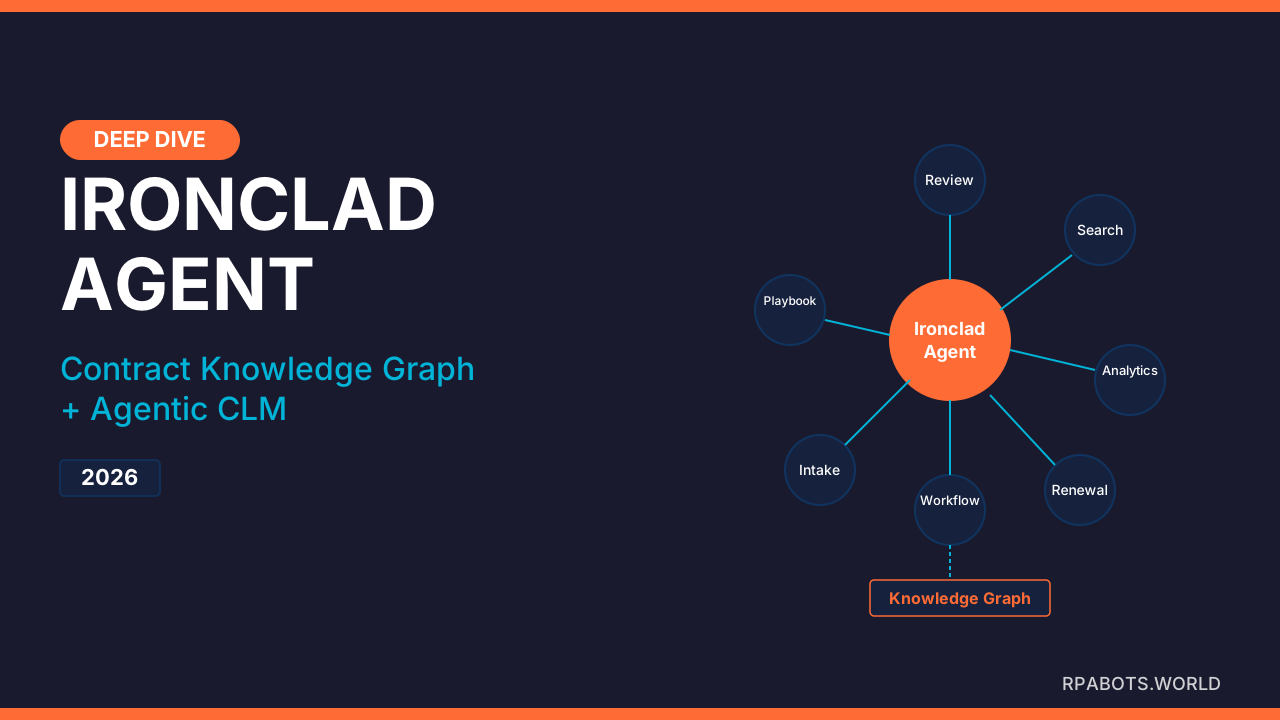
Ironclad Agent is not a single chatbot bolted onto a contract repository. It is a conversational orchestration layer that sits atop Ironclad’s CLM platform and routes user queries to a fleet of purpose-built agents. Each agent is specialized for a distinct stage of the contract lifecycle — intake, review, search, analytics, renewal, workflow design — and they share a common context layer through the Contract Knowledge Graph.
When a user asks Ironclad Agent a question like “What is our total spend with Sedona Networks across all divisions?”, the system does not simply run a keyword search. The Analytics Agent queries the CKG, identifies all contracts linked to that counterparty (including related entities grouped into a contract family hierarchy), aggregates spend data across years, and returns a structured answer. If the user follows up with “Are there any upcoming renewal windows where we could renegotiate?”, the Renewal Agent takes over, surfaces documented obligation misses and expiring terms, and recommends negotiation leverage — all grounded in the organization’s own deal history.
This is the architectural pattern that makes Ironclad Agent significant for agentic AI architects: agent specialization with shared context. Each agent has a narrow domain of expertise, but all agents read from and write to the same knowledge graph. The orchestration layer handles routing, and the user interacts through a single conversational interface without needing to know which agent is doing the work.
The Agent Fleet: What Ships Today and What Is Coming
Ironclad’s agent roster is already substantial, with a mix of generally available and early-access agents:
| Agent | Function | Status |
|---|---|---|
| Ironclad Agent | Conversational orchestrator — routes queries, retains user preferences across sessions | GA |
| Search Agent | Natural-language search across contracts, clauses, and metadata | GA |
| Analytics Agent | Spend breakdowns, trend analysis, portfolio-level reporting | GA |
| Contract Family Agent | Groups related contracts into supplier hierarchies automatically, without manual tagging | GA |
| Workflow Designer Agent | Builds and modifies approval workflows through conversation, audits for gaps | GA |
| Intake Agent | Reads uploaded agreements, identifies applicable workflows, pre-fills forms | GA |
| Contract Review Agent | Playbook- and precedent-based redlining, flags deviations from approved positions | GA |
| Archive Agent | Manages contract storage, retrieval, and lifecycle status | GA |
| Renewal Agent | Surfaces renewal windows, obligation misses, and savings opportunities | GA |
| Playbook Agent | Generates first-draft playbooks from historical precedents and repository data | Early Access |
The Workflow Designer Agent deserves particular attention from automation architects. Rather than requiring users to drag-and-drop approval flows in a visual editor, it accepts conversational instructions — “Add a VP-level approval step for any contract over $100K that involves data processing” — and translates them into workflow configurations. It checks new fields against existing ones to avoid duplicates, supports bulk changes, and can audit existing workflows for gaps. This is essentially an agentic process designer: the same conceptual pattern that Power Automate is pursuing with self-healing desktop flows, applied to contract approval routing.

The Contract Knowledge Graph: Architecture and Why It Matters
The Contract Knowledge Graph is the architectural backbone that differentiates Ironclad’s approach from conventional contract AI tools. Most CLM platforms with AI capabilities — including products from Icertis, DocuSign, and Agiloft — analyze contract text. They can extract clauses, identify entity names, and flag non-standard language. But they operate on documents in isolation. When you ask them to review a new vendor agreement, they compare it against a static playbook or a set of predefined rules. They do not know what your organization actually accepted in the last five deals with similar vendors, what negotiation positions were approved by legal leadership, or which counterparty concessions were traded for which of your own.
The CKG changes this by mapping not just what contracts say, but the relationships and decisions around them:
- Clause-level mapping: Every clause, across every contract in the portfolio, is parsed, classified, and linked to related clauses in other agreements. An indemnification clause in a vendor agreement is connected to indemnification clauses in your templates, your playbook positions, and your prior negotiated outcomes.
- Obligation tracking: Post-signature commitments — rebates, discounts, compliance requirements, termination rights, payment terms — are extracted and tracked as first-class entities in the graph, not buried in document text.
- Negotiation history: The CKG records what positions were proposed, what was accepted, what was rejected, and what trade-offs were made. This gives agents the ability to recommend positions based on precedent, not just policy.
- Counterparty relationships: The Contract Family Agent automatically groups related agreements to reveal that a counterparty is, for instance, simultaneously a customer under one agreement and a vendor under three others — a relationship that affects negotiation leverage but is invisible when contracts are managed as isolated documents.
For RPA architects accustomed to building document-processing automations, the CKG represents a fundamental shift. Traditional contract automation extracts data from documents. The CKG extracts knowledge — the kind of institutional context that previously existed only in the heads of senior legal counsel and procurement managers. IDC research cited in Ironclad’s press release found that 86% of organizations say disconnected contract processes delay revenue and purchasing cycles. World Commerce and Contracting estimates that companies lose an average of 11% of negotiated value when contract terms go untracked and unenforced. The CKG is Ironclad’s answer to both problems.
Under the Hood: Rivet, Multi-Model Orchestration, and the Technical Stack
Ironclad’s AI architecture runs on several components that are worth understanding for anyone building agentic systems:
Rivet — Open-Source Visual AI Chains. Ironclad built and open-sourced Rivet, a visual programming environment for constructing AI processing chains. Rivet graphs are defined in YAML, can be version-controlled and code-reviewed like any other infrastructure artifact, and support multi-step agent workflows. When Ironclad Agent routes a query to the Contract Review Agent, the underlying chain of operations — document retrieval, clause extraction, playbook comparison, deviation flagging, redline generation — is defined as a Rivet graph. This is architecturally similar to how LangGraph defines agent workflows as directed graphs, but with a visual editor that makes the chain inspectable by non-engineers.
Multi-Model Strategy. Ironclad uses different models for different tasks rather than routing everything through a single LLM. Independent analysis of the platform identifies at least a clause-detection model tuned for contract-specific language and a separate model for negotiation support. The platform’s generative features use OpenAI’s API (currently GPT-5.1, after the retirement of GPT-4o in September 2026), with customer data excluded from model training. Customers can opt out of generative AI features entirely.
Infrastructure. Ironclad runs on Google Cloud and Kubernetes, with data export capabilities to Snowflake for enterprise analytics. The platform has processed over one billion contracts (both public and customer data) for model training.
Policy-Based Access Control: A Governance Model for Agentic Systems
One of the most underappreciated announcements in the October launch is Policy-Based Access Control (PBAC), which replaces traditional role-based access control (RBAC) for agent interactions.
The problem with RBAC in agentic systems is well-documented. When a human user interacts with a contract, RBAC checks their role — legal counsel, procurement analyst, sales rep — and grants or denies access accordingly. But when an AI agent interacts with a contract on behalf of a user, the access control question becomes more complex. Which agent is making the request? On whose behalf? What is the context of the query? Does the user’s role grant access to the specific counterparty, contract type, and clause category involved?
PBAC evaluates each request dynamically based on both the user and the resource being accessed, rather than relying on static role assignments. Access rules are stored as reusable policies, and agent interactions inherit the same checks as direct user interactions. This means the Contract Review Agent cannot access contracts that the user requesting the review is not authorized to see, even if the agent itself has broad technical access to the repository.
This is a design pattern that every agentic AI architect should internalize. As AI agents proliferate across enterprise systems, the question of how to govern agent access to sensitive data becomes critical. The approach Ironclad has taken — context-aware policies that evaluate user, resource, and request context at invocation time — aligns with the broader trend toward agent governance frameworks like NVIDIA’s Open Agent Safety Platform and the emerging agent identity standards from RSA.
What This Means for RPA Teams
If your organization currently uses RPA bots for contract-related automation — and many do, since contract data extraction, approval routing, and renewal notifications are among the most common RPA use cases — Ironclad Agent raises important architectural questions about the future of those workflows.
Where RPA Still Wins
RPA excels at deterministic, high-volume tasks that move data between systems. If you have a bot that pulls signed contracts from email, extracts the counterparty name and effective date, and creates a record in your ERP, that bot is fast, reliable, and cheap to run. Ironclad Agent is not designed to replace it. The agent-based approach adds value where structured extraction is not enough — where the task requires reasoning about context, history, and relationships.
Where Agentic CLM Changes the Game
Consider a scenario that every procurement team faces: a vendor sends a renewal agreement with a 4% annual price-uplift cap, but your organization’s standard playbook position is 3%. A traditional RPA bot cannot catch this because it does not know your playbook position. A rule-based CLM system can flag it if someone manually configured a rule for uplift caps. But Ironclad’s Contract Review Agent goes further — it checks the playbook, checks what your organization actually accepted in prior deals with this vendor and similar vendors, and recommends a redline position grounded in precedent. That is the difference between data extraction and knowledge-grounded reasoning.
For RPA architects planning their automation roadmaps, the practical implication is this: document-level extraction and system-to-system data movement remain strong RPA use cases, but the cognitive layer — interpretation, comparison, recommendation — is shifting to agentic platforms that can access institutional knowledge. The smart play is to build integrations between your RPA infrastructure and platforms like Ironclad, using the MCP-based interoperability patterns that are becoming standard across the agentic ecosystem, rather than trying to replicate knowledge-graph reasoning inside an RPA bot.
Competitive Landscape: How Ironclad Agent Stacks Up
Ironclad is not the only CLM vendor adding agentic AI capabilities. Here is how the competitive landscape looks as of October 2026:
| Vendor | AI Agent Approach | Knowledge Grounding | Agent Governance |
|---|---|---|---|
| Ironclad | Fleet of 10+ specialized agents with conversational orchestration | Contract Knowledge Graph (clause-level, obligation, negotiation history) | PBAC with context-aware policies |
| Icertis | AI modules for obligation extraction and clause suggestions | Contract-text analysis | Role-based |
| DocuSign | AI-assisted agreement preparation and analysis | Document-level | Role-based |
| Agiloft | AI clause detection and auto-classification | Repository search | Role-based |
| SirionOne | AI for obligation management and compliance | Obligation extraction | Role-based |
Ironclad’s differentiation centers on two claims: first, that the Contract Knowledge Graph provides deeper context than document-text analysis alone; second, that the agent fleet covers the full lifecycle rather than offering AI as point features (extract this clause, flag that deviation). Whether those claims hold up in enterprise-scale deployments is something each organization will need to evaluate against its own portfolio complexity and negotiation sophistication.
The CLM Market Context
The contract lifecycle management market is valued at approximately $1.4 billion to $1.56 billion in 2025, according to estimates from Custom Market Insights, Market Research Future, and Future Market Insights, with projected growth to $3.3 billion to $5.7 billion by the mid-2030s at a 12-14% CAGR. AI-powered contract tools are a primary growth driver — industry benchmarks suggest that AI-assisted review can reduce contract task time by up to 82% compared to fully manual processes.
Ironclad itself has raised $334 million across seven funding rounds, with a $3.2 billion valuation set during its Series E in January 2022, led by Franklin Templeton. The company is backed by Sequoia Capital, Accel, Y Combinator, and Bond. Pricing is quote-based, with industry estimates suggesting a median enterprise contract around $130,000 per year, plus implementation fees ranging from $5,000 to $75,000+.
Architectural Lessons for Agentic AI Builders
Whether or not you work in contract management, the Ironclad Agent architecture contains patterns that apply to any enterprise agentic AI deployment:
1. Knowledge Graphs as the Agent Context Layer
The most common mistake in enterprise agent deployments is giving agents access to raw data — documents, databases, APIs — without an intermediate knowledge layer that captures relationships and institutional context. Ironclad’s CKG is purpose-built for contracts, but the pattern is universal. If you are building agentic automation for procurement, HR, finance, or operations, consider what a domain-specific knowledge graph would look like for your function. What relationships exist between entities that are invisible in flat data? What institutional knowledge lives in people’s heads that could be captured as graph relationships?
2. Agent Specialization Over Monolithic Agents
Ironclad does not have one “contract AI agent” that does everything. It has a fleet of specialized agents — intake, review, search, analytics, renewal, workflow design — each optimized for a specific stage of the lifecycle. This specialization pattern improves accuracy (each agent can be tuned and evaluated independently), enables parallel development (different teams can build different agents), and makes the system more debuggable (when something goes wrong, you know which agent misbehaved). This aligns with the multi-agent orchestration patterns championed by frameworks like Pydantic AI’s composable agent architecture and the emerging standards from the Agentic AI Foundation.
3. Governance as a First-Class Architectural Concern
Ironclad shipped PBAC alongside its agent fleet, not as an afterthought. This reflects a growing recognition that agent governance cannot be retrofitted. When agents can reason about sensitive contract terms, negotiation positions, and counterparty relationships, the access control model must be at least as sophisticated as the agents themselves. Role-based access is not enough — you need context-aware policies that evaluate the user, the resource, and the nature of the request together.
4. Open-Source Tooling for Agent Orchestration
Ironclad open-sourced Rivet, the visual AI chain framework that powers its agent orchestration. This is a strategic pattern: by open-sourcing the orchestration layer, Ironclad builds community trust, enables independent auditability of its AI workflows, and creates a talent pool of developers familiar with its tooling. For enterprise buyers evaluating agentic platforms, the availability of open-source components in the stack is increasingly a differentiator — it reduces vendor lock-in risk and enables internal teams to inspect and extend the system.
Getting Started: What to Evaluate
If you are considering Ironclad Agent for your organization, or if you are evaluating agentic CLM approaches more broadly, here is a practical evaluation framework:
- Portfolio complexity audit. Count how many active contracts your organization manages, how many counterparties appear in multiple roles (customer, vendor, partner), and how many negotiated positions differ from your standard playbook. The more complex these relationships, the more value a knowledge-graph-based approach provides over document-text analysis.
- Current automation inventory. Map your existing contract-related RPA bots and integrations. Identify which handle pure data movement (keep them) and which attempt cognitive tasks like clause comparison or deviation flagging (candidates for replacement or augmentation by agentic CLM).
- Governance readiness. Assess whether your current access control model can handle agent-mediated access to contract data. If you are using RBAC today, plan for the transition to context-aware policies.
- Integration requirements. Ironclad offers integrations with SAP Ariba, SAP S/4HANA, Salesforce, Slack, and Microsoft Word. Verify that your existing procurement and ERP stack is supported before committing.
- Pilot scope. Start with the agent that addresses your biggest pain point. For procurement-heavy organizations, the Renewal Agent (surfacing savings opportunities from obligation misses) often delivers the fastest ROI. For legal teams drowning in review cycles, the Contract Review Agent with precedent-based redlining is the natural starting point.
Frequently Asked Questions
What is the Ironclad Contract Knowledge Graph?
The Contract Knowledge Graph (CKG) is Ironclad’s proprietary engine that maps every clause, obligation, counterparty relationship, and negotiation decision across an organization’s contract portfolio. Unlike traditional contract repositories that store and search document text, the CKG captures the relationships between contract elements — what positions were negotiated, what was accepted or rejected, and how different agreements relate to each other. This institutional knowledge is what grounds Ironclad Agent’s recommendations in precedent rather than generic AI training data.
How does Ironclad Agent differ from RPA-based contract automation?
RPA bots for contract management typically handle deterministic tasks: extracting fields from PDFs, routing documents for approval, and triggering notifications for upcoming renewals. Ironclad Agent operates at a higher cognitive level — it reasons about negotiation history, compares proposed terms against precedent, and recommends positions grounded in the organization’s own deal history. The two approaches are complementary: RPA handles system-to-system data movement, while agentic CLM handles the interpretation and decision-support layer.
What AI models does Ironclad Agent use?
Ironclad uses a multi-model strategy with different models optimized for different tasks, including a clause-detection model tuned for contract-specific language and a separate model for negotiation support. Generative features use OpenAI’s API (currently GPT-5.1), with customer data excluded from model training. Customers can opt out of generative AI features. The orchestration layer runs on Rivet, Ironclad’s open-source visual AI chain framework.
How much does Ironclad cost?
Ironclad pricing is quote-based with two tiers: Business (for in-house legal teams, estimated at $20K–$50K per year) and Enterprise (for large organizations, with custom pricing). Industry estimates suggest a median enterprise contract around $130,000 per year. Implementation and onboarding fees range from $5,000 to $75,000+, depending on portfolio size and integration complexity.
Can Ironclad Agent integrate with existing RPA and automation platforms?
Ironclad offers native integrations with SAP Ariba, SAP S/4HANA, Salesforce, Slack, and Microsoft Word. For RPA integration, the platform provides a CLM API and Clickwrap API that can be called from automation workflows built in UiPath, Power Automate, or Automation Anywhere. The Rivet orchestration framework uses YAML-defined graphs that can be version-controlled and extended.
Key Takeaways
- Ironclad Agent is a fleet of 10+ specialized AI agents that cover the full contract lifecycle — intake, review, redlining, search, analytics, renewal, and workflow design — orchestrated through a single conversational interface.
- The Contract Knowledge Graph (CKG) captures clause-level relationships, negotiation history, and counterparty connections across the entire portfolio, grounding agent recommendations in institutional precedent rather than generic AI training data.
- Policy-Based Access Control (PBAC) replaces RBAC for agent governance, evaluating user identity, resource sensitivity, and request context dynamically on each interaction.
- The multi-agent specialization pattern — purpose-built agents sharing a common knowledge layer — is an architectural blueprint applicable to any enterprise domain, not just contract management.
- RPA-based contract automation and agentic CLM are complementary: RPA handles deterministic data movement, while agentic platforms handle reasoning, comparison, and recommendation grounded in knowledge graphs.
- Ironclad open-sourced Rivet, its visual AI chain framework, enabling independent auditability and reducing vendor lock-in — a pattern worth watching in enterprise agentic AI.
References
- Ironclad, “Ironclad Launches New AI Agents Grounded in Commercial Context” — Press Release, October 8, 2026
- Ironclad, “Meet Ironclad Agent” — Product Overview, October 2026
- Ironclad, “Ironclad Launches AI Agents to Help Procurement Teams” — Press Release, August 5, 2026
- IDC, cited in Ironclad press release — 86% of organizations report disconnected contract processes delay revenue
- World Commerce and Contracting — Estimated 11% average loss of negotiated contract value
- Custom Market Insights, Market Research Future, Future Market Insights — CLM market size estimates ($1.4B–$1.56B, 2025)
- HyperStart, “Contract Management Market Size” — Market analysis, 2026
- Clay, “How Much Did Ironclad Raise?” — Funding data
- Ironclad, Rivet — The Open-Source Visual AI Programming Environment
- IntuitionLabs, “Ironclad AI Capabilities: Contract Management Deep Dive”


