



Why Open Source Is Winning the Agentic AI Race
In January 2026, a single open-source AI agent framework called OpenClaw had 9,000 GitHub stars. By July, it had surpassed 382,000 — overtaking React, Vue.js, and every other software project in GitHub history. That trajectory alone tells you something fundamental has shifted in how practitioners build autonomous AI systems.
- Why Open Source Is Winning the Agentic AI Race
- Comparison Table: 8 Trending Open-Source Agentic AI Repos at a Glance
- 1. OpenClaw — The Most-Starred AI Agent Framework in GitHub History
- 2. n8n — Workflow Automation Meets AI Agent Orchestration
- 3. Firecrawl — The Web Scraping API Built for AI Agents
- 4. Langflow — Visual Agent Builder Gone Open Source
- 5. Dify — The Production-Ready AI Agent Workflow Platform
- 6. Browser-Use — Teaching AI Agents to Use the Web Like Humans
- 7. OpenHands — AI-Driven Software Development
- 8. Langfuse — Open-Source Observability for Your AI Agents
- What These Repos Tell Us About the Agentic AI Landscape in 2026
- How to Choose the Right Repo for Your Use Case
- Frequently Asked Questions
- Which open-source agentic AI repo has the most GitHub stars in 2026?
- Are these open-source repos production-ready for enterprise use?
- How do these repos handle the EU AI Act transparency requirements?
- Can I use these repos alongside UiPath or other commercial RPA platforms?
- What programming language skills do I need to use these repos?
- Key Takeaways
- References
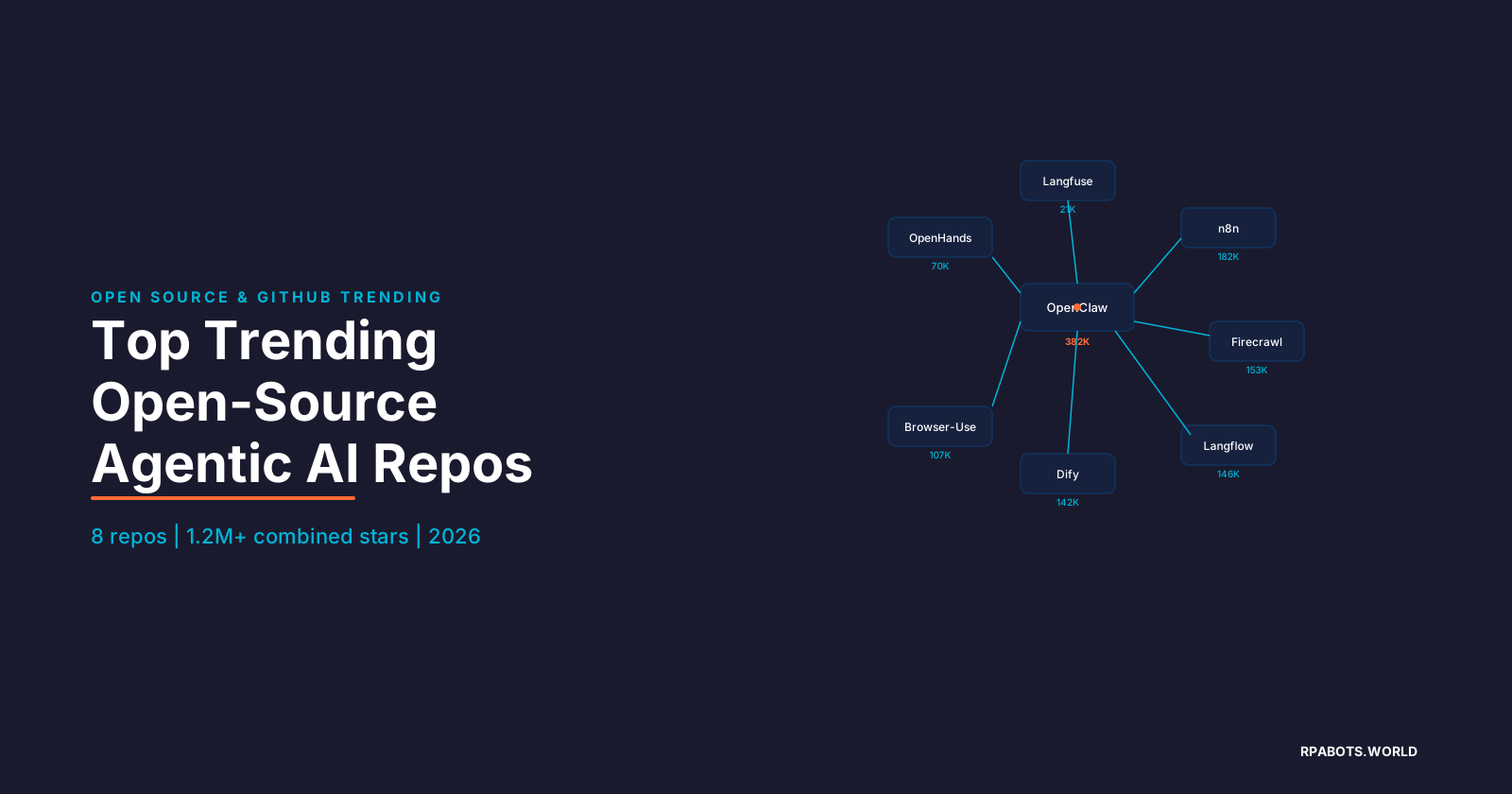
But OpenClaw is not an isolated story. Across the agentic AI landscape, open-source repositories are accumulating stars at rates that would have seemed implausible two years ago. Workflow automation platforms like n8n have crossed 182,000 stars. Web scraping infrastructure built specifically for AI agents — Firecrawl — sits at 153,000. Visual agent builders, observability platforms, and browser automation frameworks are all growing at double-digit monthly rates.
The combined GitHub star count for the eight repositories in this roundup exceeds 1.2 million. More importantly, these are not vanity stars on abandoned projects — every repo on this list shipped a meaningful release in the last 90 days, and several have active enterprise deployments at Fortune 500 companies.
For RPA developers, solution architects, and automation engineers evaluating their next platform bet, these repos represent the building blocks of production agentic systems. Some replace vendor-locked tools you are already paying for. Others fill gaps — browser automation, agent observability, web data ingestion — that no single vendor covers well.
This roundup covers what each project does, why it is trending, who should use it, and where it fits in a production agent stack. If you are building enterprise agent control planes, several of these repos are the open-source primitives underneath.
Comparison Table: 8 Trending Open-Source Agentic AI Repos at a Glance
| Repository | GitHub Stars | Language | License | One-Line Pitch |
|---|---|---|---|---|
| OpenClaw | 382,000+ | TypeScript / Python | MIT | Self-hosted AI agent runtime with 100+ built-in skills, long-term memory, and proactive automation |
| n8n | 182,000+ | TypeScript | Sustainable Use | Visual workflow automation platform with native AI agent nodes and 400+ integrations |
| Firecrawl | 153,000+ | TypeScript / Python | AGPL-3.0 | Web scraping API that converts any page into LLM-ready markdown with 96% web coverage |
| Langflow | 146,000+ | Python | MIT | Drag-and-drop visual builder for AI agents and RAG pipelines with MCP support |
| Dify | 142,000+ | Python / TypeScript | Apache-2.0 (modified) | Production-ready AI app platform with visual workflows, built-in RAG, and bidirectional MCP |
| Browser-Use | 107,000+ | Python | MIT | Gives AI agents the ability to interact with websites — clicking, typing, and navigating autonomously |
| OpenHands | 70,000+ | Python | MIT | AI-driven software development platform with composable code agent SDK |
| Langfuse | 21,000+ | TypeScript | MIT (core) | Open-source LLM and agent observability — tracing, evaluation, and prompt management |
Star counts sourced from GitHub and verified tech publications as of late July 2026. Counts change daily — check each repo for the latest figure.
1. OpenClaw — The Most-Starred AI Agent Framework in GitHub History
What It Does
OpenClaw is a self-hosted AI agent framework that goes beyond chatbot interfaces to deliver a true personal AI agent runtime. Rather than wrapping an API call in a chat window, OpenClaw provides long-running session management, persistent memory across conversations, and the ability to autonomously create new skills by writing code to accomplish tasks it has not been trained to handle.
The architecture follows a four-layer design: an access layer that normalizes inputs from multiple channels, a routing layer that matches requests to the correct agent and session, a business layer for reasoning and tool execution, and a storage layer for session state and runtime logs. After a 2026 refactor, the core weighs approximately 8MB — model providers are loaded as external plugins, keeping the runtime lightweight.
Why It Is Trending
OpenClaw’s growth trajectory is unlike anything GitHub has seen. It went from 9,000 stars in January 2026 to over 100,000 by February, reaching 250,829 on March 3 to surpass React — a milestone that took React over a decade to reach. By July 2026, the repo sat above 382,000 stars with a peak velocity of 12,000 stars per day, according to Star History.
The July 2026 releases (v2026.7.1 and v2026.7.2) added GPT-5.6 compatibility, crash-recoverable SQLite snapshots, session rewind and branching, and expanded MCP app support. Enterprise security features — including a quarantine store that survives primary-database damage — are a significant reason Fortune 500 companies have adopted it for internal agent deployments.
Who Should Use It
Automation architects who want a self-hosted alternative to vendor-locked agent platforms. Teams already running RPA workflows who need a general-purpose AI agent layer that can orchestrate across multiple tools and maintain context over long-running processes. If you have explored the relationship between prompts, context, and loops in AI engineering, OpenClaw operationalizes those concepts at the infrastructure level.
What to Watch
Security researchers have published multiple analyses of OpenClaw’s threat surface (at least three arXiv papers in 2026 alone), which is both a sign of its importance and a reminder that self-hosted agent runtimes introduce a new class of governance challenges. Treat its security model as an evolving surface, not a solved problem.
2. n8n — Workflow Automation Meets AI Agent Orchestration
What It Does
n8n is an open-source workflow automation platform that has been in active development for seven years — long before “agentic AI” became a category. What makes it relevant to this roundup is its 2026 transformation into a full AI agent orchestration layer. The rebuilt AI Agent node (v1.28, January 2026) supports structured tool calling across Claude, GPT-4o, Gemini, Mistral, Groq, and OpenAI-compatible endpoints, with four memory management backends (in-memory, Redis, Postgres, and Motorhead) and a ReAct execution mode.
The platform offers over 400 native integrations, a visual canvas UI that replaced the flat workflow builder, and native Model Context Protocol (MCP) support added in 2026 — covering services like Apify, Linear, monday.com, Notion, and PostHog.
Why It Is Trending
With 182,000+ GitHub stars, n8n is the most-starred workflow automation platform in the world. Its growth reflects a broader trend: drag-and-drop visual interfaces are becoming the preferred way to design AI agent pipelines, letting domain experts beyond ML engineers create sophisticated agentic workflows. A June 2026 debugging engine that traces variables line-by-line in JavaScript and Python nodes during failed runs addressed one of the biggest complaints about visual automation tools — opacity during failures.
Human-in-the-loop approval, where specific AI Agent tools require manual sign-off before execution, bridges the gap between full autonomy and the governance failures that derail agentic automation programs.
Who Should Use It
RPA developers and citizen automators who want to add AI agent capabilities to existing workflow automations without learning a new framework. Teams that need visual orchestration of multi-step processes combining API calls, database queries, and LLM reasoning. n8n is particularly strong for operations teams that need agents with guardrails — the human approval gates and per-node retry logic with exponential backoff make it production-friendly in regulated environments.
3. Firecrawl — The Web Scraping API Built for AI Agents
What It Does
Firecrawl converts any web page into clean markdown, structured JSON, or screenshots optimized for direct LLM consumption. It covers 96% of the web including JavaScript-heavy single-page applications, with a P95 latency of 3.4 seconds and output that uses 93% fewer input tokens than raw HTML. For AI agents that need to gather information from the web, Firecrawl eliminates the data-wrangling layer that typically sits between a crawler and an LLM.
The most significant capability for agent builders is the Agent endpoint: instead of specifying URLs or writing extraction logic, you describe what data you need, and Firecrawl’s built-in agent searches, navigates, and retrieves it autonomously. Additional features include media parsing for web-hosted PDFs and DOCX files, interactive actions (clicking, scrolling, form-filling) before extraction, and native MCP client connectivity.
Why It Is Trending
Firecrawl has crossed 153,000 GitHub stars and is ranked in the top 100 repositories globally. MCP usage alone grew 35% in a single recent month. The YC-backed project fills a specific gap in the agentic AI stack: reliable, structured web data ingestion. Without it, agents that need real-time web information either hallucinate or require custom scraping pipelines that break whenever a target site changes its DOM.
Who Should Use It
Any team building agents that need to interact with web content — research agents, competitive intelligence bots, lead enrichment pipelines, or content monitoring systems. If your RPA workflows currently use fragile screen-scraping for web data, Firecrawl’s API-first approach with structured output is a significantly more maintainable alternative. The self-hosted option makes it viable for teams with data sovereignty requirements.
4. Langflow — Visual Agent Builder Gone Open Source
What It Does
Langflow is a visual, low-code platform for building AI agents, RAG pipelines, and multi-step AI workflows using a node-based drag-and-drop interface. Components represent LLMs, vector stores, document loaders, text splitters, embedding models, and custom Python code — users connect them visually to create agent flows that would otherwise require hundreds of lines of orchestration code.
Version 1.8, released in March 2026, introduced global model provider configuration, a V2 Workflow API, and native MCP server and client support. Langflow can both consume MCP tools from external servers and expose its own flows as MCP servers — making any Langflow agent callable from Claude Desktop, Cursor, or other MCP-enabled environments.
Why It Is Trending
At 146,000+ stars, Langflow represents the “visual-first” approach to agent building that is clearly resonating with the developer community. The project went through a significant transition in early 2026: DataStax’s managed Langflow hosting was deprecated in March 2026 and shut down in April, pushing the project fully into self-hosted and community-driven territory. Rather than killing momentum, this shift actually accelerated open-source contributions — the MIT license and Docker/Kubernetes deployment path made enterprise adoption easier, not harder.
Who Should Use It
Teams that want to prototype agent flows visually before committing to a code-heavy framework. Solution architects who need to demonstrate agent architectures to business stakeholders — the visual canvas makes flows legible to non-developers. If you have been evaluating frameworks like LangGraph vs CrewAI vs Microsoft Agent Framework, Langflow sits in a different niche: it is not a framework competitor but a visual orchestration layer that can use those frameworks as components.
5. Dify — The Production-Ready AI Agent Workflow Platform
What It Does
Dify combines a visual workflow builder for no-code AI pipelines, a built-in RAG engine for document-grounded responses, and an agent framework supporting both ReAct and Function Calling reasoning strategies — all in one platform. With over 800 contributors, 10,273+ commits, and weekly releases, it is one of the most actively maintained projects in the agentic AI space.
The 2026 additions that matter most for agent builders are bidirectional MCP support: as an MCP client, Dify agents can connect to any external MCP server (filesystems, GitHub, Slack, databases, web browsers). As an MCP server, any Dify app — Chatflow, Workflow, or Agent — can be published as a tool consumable by Claude Desktop, Cursor, or any MCP-enabled client. This means a Dify agent becomes a callable component in a larger agent ecosystem, not just a standalone application.
Why It Is Trending
Dify crossed 142,000 GitHub stars by July 2026, with 22,000 forks and 180,000+ active developers. It has surpassed 1 million deployed applications. The project’s growth rate outpaced LangChain in late 2025, and its production focus — with built-in annotation, evaluation, and monitoring capabilities — positions it as the “batteries-included” alternative to assembling an agent stack from individual libraries.
Who Should Use It
Teams that want a single platform covering agent building, RAG, and deployment without stitching together LangChain + a vector database + a custom UI + a monitoring tool. The self-hosted Community Edition is free, making it accessible for teams evaluating agent platforms before committing budget. The bidirectional MCP support makes Dify particularly interesting for organizations already invested in MCP-based architectures — your Dify agents can participate in the same tool ecosystem as your UiPath automations or LangGraph agents deployed on UiPath.
6. Browser-Use — Teaching AI Agents to Use the Web Like Humans
What It Does
Browser-Use gives AI agents the ability to interact with websites the way a human would — clicking buttons, typing into fields, navigating between pages, and extracting information from rendered content. Rather than relying on APIs or structured data endpoints (which many web applications do not expose), Browser-Use lets agents work with the web as it actually exists: a collection of HTML pages designed for human interaction.
The project handles the entire browser automation lifecycle: element detection, action execution, state management, error recovery, and result extraction. It can be integrated with any LLM that supports function calling, making it a drop-in browser capability for agents built on LangGraph, CrewAI, or custom frameworks.
Why It Is Trending
Browser-Use grew from 10,000 stars in January 2026 to over 107,000 by mid-year — a 10x increase in six months. This growth reflects a fundamental limitation in current agent architectures: most real-world processes require interacting with web applications that have no API. The AI browser automation market is projected to reach $76.8 billion by 2034 (32.8% CAGR), and Browser-Use is the leading open-source option in that space.
Fortune 500 companies have adopted Browser-Use for internal agent deployments where the target systems — legacy portals, vendor dashboards, government filing sites — offer no programmatic access. For RPA practitioners, this is familiar territory: Browser-Use solves the same problem as UI automation in traditional RPA, but with an LLM deciding what to click instead of a hardcoded selector.
Who Should Use It
RPA developers building agents that need to interact with web applications lacking APIs. Teams migrating from traditional screen-scraping RPA to agentic approaches. Browser-Use is the open-source answer to the question every automation architect asks: how does my agent interact with a system that only has a web UI?
7. OpenHands — AI-Driven Software Development
What It Does
OpenHands (originally OpenDevin) is an AI-driven development platform that provides code agents with composable tools and isolated execution environments. The OpenHands Software Agent SDK is a modular Python SDK for building code agents with local or ephemeral workspaces — agents can write, test, debug, and deploy code autonomously while maintaining safety boundaries through containerized execution.
The project started as a community response to Cognition AI’s Devin announcement and has since raised $18.8 million in Series A funding. Contributors include engineers from AMD, Apple, Google, Amazon, Netflix, and NVIDIA — a breadth of backing that signals the project is more than a research experiment.
Why It Is Trending
At 70,000+ GitHub stars, OpenHands represents a category — autonomous coding agents — that is directly relevant to RPA development teams. If your automation practice involves writing UiPath workflows, Python scripts, or API integrations, OpenHands-style agents can accelerate development by handling boilerplate code, debugging failures, and generating test cases. The growing demand for agentic AI skills in the job market reflects this shift: organizations want developers who can build agents and use agents to build.
Who Should Use It
Development teams building automation solutions who want AI-assisted coding that goes beyond autocomplete. Platform teams evaluating code agents for internal developer productivity. OpenHands is particularly relevant if your RPA practice generates significant custom code (Python activities, .NET custom activities, API integrations) alongside visual workflow design.
8. Langfuse — Open-Source Observability for Your AI Agents
What It Does
Langfuse is an open-source AI engineering platform covering end-to-end tracing, prompt management, evaluation, and datasets for LLM applications. For agent builders specifically, Langfuse captures every step an AI agent takes — LLM calls, tool invocations, retrievals, and control-flow decisions — extending observability from single completions to the multi-step, non-deterministic workflows that define agentic systems.
The MIT-licensed core integrates with OpenTelemetry, LangChain, OpenAI SDK, LiteLLM, and other frameworks. It was acquired by ClickHouse in 2026, signaling long-term investment in its data infrastructure layer.
Why It Is Trending
At 21,000+ stars, Langfuse is the most widely adopted open-source LLM observability platform. Its growth reflects a maturation in the agentic AI market: teams that shipped agents in 2025 are now realizing they cannot debug, optimize, or govern what they cannot observe. The EU AI Act’s Article 50 transparency requirements, which took effect on August 2, 2026, add regulatory urgency — organizations deploying AI agents that interact with individuals must be able to trace agent actions and demonstrate compliance. Langfuse provides the instrumentation layer to meet these requirements.
Who Should Use It
Any team running AI agents in production. If you are building agent control planes for enterprise governance, Langfuse is the observability primitive that feeds your governance dashboard. RPA teams adding AI agent capabilities to existing automations should instrument from day one — retrofitting observability after deployment is significantly more expensive than building it in.
What These Repos Tell Us About the Agentic AI Landscape in 2026
Three patterns emerge from this roundup that matter for practitioners planning their next moves:
The stack is unbundling and re-bundling simultaneously. Specialized tools (Firecrawl for web data, Browser-Use for web interaction, Langfuse for observability) are winning their individual categories with focused solutions. At the same time, platforms like Dify and n8n are absorbing multiple capabilities into integrated environments. The winning strategy for most teams will be a platform core (Dify, n8n, or a vendor platform) with specialized open-source tools plugged in where the platform falls short.
MCP is becoming the connective tissue. Five of the eight repos in this roundup now support the Model Context Protocol in some form — as clients, servers, or both. This is not a coincidence. MCP provides the interoperability layer that lets these tools compose into agent stacks without custom integration code. If you are evaluating any of these repos, MCP support should be a weighted criterion in your decision.
Observability and governance are no longer optional. The EU AI Act’s Article 50 transparency requirements took effect on August 2, 2026, with fines reaching €15 million or 3% of global annual turnover. Langfuse’s growth is a leading indicator: teams are instrumenting their agent stacks because they have to, not just because they want to. If you are building agentic automation programs that do not fail, observability is a structural requirement, not a nice-to-have.
How to Choose the Right Repo for Your Use Case
| Use Case | Start Here | Add This |
|---|---|---|
| Personal AI agent / assistant | OpenClaw | Browser-Use for web interaction |
| Visual workflow automation with AI | n8n | Firecrawl for web data ingestion |
| Building RAG + agent apps | Dify or Langflow | Langfuse for observability |
| Web scraping for AI pipelines | Firecrawl | n8n for orchestration |
| Browser automation for agents | Browser-Use | OpenClaw or LangGraph as the agent runtime |
| AI-assisted RPA development | OpenHands | Langfuse to trace agent behavior |
| Agent monitoring and compliance | Langfuse | Any agent framework above |
Frequently Asked Questions
Which open-source agentic AI repo has the most GitHub stars in 2026?
OpenClaw leads with over 382,000 GitHub stars as of July 2026, making it the most-starred AI agent framework in GitHub history. It surpassed React’s star count in March 2026 — reaching in 60 days what took React over 10 years. The next closest in this category is n8n at 182,000+ stars, though n8n is primarily a workflow automation platform with AI agent capabilities rather than a pure agent framework.
Are these open-source repos production-ready for enterprise use?
Several are already deployed at Fortune 500 companies. OpenClaw added enterprise security features (crash-recoverable snapshots, quarantine stores) in its July 2026 releases. n8n has been in production use for seven years across thousands of organizations. Dify has surpassed 1 million deployed applications. Langfuse was acquired by ClickHouse specifically to strengthen its enterprise infrastructure. However, production readiness depends on your specific requirements — evaluate each project’s security model, support options, and license terms against your organization’s policies.
How do these repos handle the EU AI Act transparency requirements?
The EU AI Act’s Article 50 transparency obligations took effect August 2, 2026, requiring that AI systems interacting with individuals disclose their AI nature and maintain traceable records of agent actions. Langfuse provides the observability layer to instrument agent traces for compliance. OpenClaw’s session logging and Dify’s built-in monitoring also support compliance workflows. However, no single repo solves EU AI Act compliance end-to-end — organizations need to combine agent-level instrumentation with organizational policies and governance frameworks.
Can I use these repos alongside UiPath or other commercial RPA platforms?
Yes. MCP support in projects like Dify, Langflow, Firecrawl, and n8n enables interoperability with commercial platforms. For example, you can build a LangGraph agent that runs on UiPath infrastructure and uses Firecrawl for web data and Langfuse for monitoring. The trend toward MCP as a standard protocol means open-source and commercial tools increasingly compose rather than compete.
What programming language skills do I need to use these repos?
Python is the most common requirement — OpenHands, Browser-Use, Langflow, and Dify are Python-based. n8n and Langfuse use TypeScript/Node.js. OpenClaw uses both TypeScript and Python. However, visual platforms like n8n, Langflow, and Dify are specifically designed to reduce code requirements — you can build functional agent workflows through their visual interfaces without writing any code, then add custom code only where needed.
Key Takeaways
- OpenClaw (382K+ stars) is the breakout repo of 2026 — a self-hosted AI agent runtime with plugin architecture, long-term memory, and enterprise security features.
- Visual builders are dominant: n8n (182K+), Langflow (146K+), and Dify (142K+) prove that drag-and-drop agent design is not a toy — it is the primary interface for production agent workflows.
- The agent data stack is maturing: Firecrawl (153K+) for web ingestion, Browser-Use (107K+) for web interaction, and Langfuse (21K+) for observability fill critical infrastructure gaps that no single framework covers.
- MCP is the de facto integration standard: Five of eight repos support Model Context Protocol, enabling open-source tools to compose with each other and with commercial platforms like UiPath.
- EU AI Act compliance (effective August 2, 2026) makes agent observability mandatory — teams deploying agents that interact with individuals need instrumentation from day one.
- Self-hosting is a first-class option: Every repo in this roundup supports self-hosted deployment, giving teams control over data sovereignty and infrastructure costs.
References
- OpenClaw GitHub Repository — github.com/openclaw
- OpenClaw Release Notes v2026.7.1 — github.com/openclaw/openclaw/releases
- “OpenClaw Just Beat React’s 10-Year GitHub Record in 60 Days” — Medium, March 2026
- Star History — “OpenClaw Surpasses Linux” — star-history.com
- n8n Release Notes 2.x — docs.n8n.io
- “n8n AI Agents in Production 2026: HITL” — BOVO Digital, 2026
- Firecrawl GitHub — github.com/firecrawl
- “Firecrawl 137K Stars: Web Scraping API for AI Agents” — explainx.ai, 2026
- Langflow Blog — “Langflow 1.0 is out” — langflow.org
- Dify GitHub — github.com/langgenius/dify
- “Dify 2026: The Open-Source AI Builder That Beat LangChain” — ThePlanetTools.ai
- Browser-Use — browser-use.com
- OpenHands GitHub — github.com/OpenHands
- Langfuse GitHub — github.com/langfuse
- “Top AI GitHub Repositories in 2026” — ByteByteGo, 2026
- “EU AI Act: What Actually Applies on 2 August 2026” — Technology.org, July 2026
- “Is it a bot? EU AI Act transparency rules” — Travers Smith, 2026
- Firecrawl Blog — “Best Open-Source Web Scraping Libraries in 2026” — firecrawl.dev
- “Open Source AI Agent Platform Comparison (2026)” — Jimmy Song, 2026
- “Top 20 GitHub Repos for AI Agents in 2026” — Fungies.io, 2026
What repo would you add to this list? Drop a comment or reach out on LinkedIn. For more practitioner-focused deep dives into the tools and frameworks shaping agentic AI, explore our framework comparison guide and LangGraph + UiPath deployment tutorial.


